

In this article
In this article
Most arguments for better governance start with overt failure. A control was bypassed, a limit exceeded, something went wrong and somebody had to explain it. The case makes itself.
The harder case is when the existing controls appear to be working. The delegation of authority is followed. Purchase orders are approved by people entitled to approve them. Commitments are recorded, reported and forecast. Nothing has been bypassed and nobody has done anything wrong. But managers may still not be making the best decisions, and the organization may not be receiving full value from the spend. That is the problem this article addresses: how to govern strategic OpEx when nothing appears to be broken.
Much CapEx is being packaged up and consumed as a service. For example, software, distribution centers and trucks are no longer only owned assets but are increasingly procured as online, logistics and transportation services. The problem is that, as with any investment, there is the potential for waste or suboptimal service or supplier selection. Commercial, technical and reputational risk is heightened when these services are no longer owned but rented from third parties.
The issue is not business-as-usual (BAU) OpEx. The problem arises when Strategic OpEx follows the same approval route as BAU OpEx simply because its accounting treatment puts it outside the capital process, even when the underlying decision is, in substance, an investment decision.
For Finance, the practical requirement is to identify significant spending decisions before they enter procurement and approval workflows. The screening criteria need to apply regardless of whether the expenditure will ultimately be treated as CapEx or OpEx. Routine BAU OpEx should continue through the normal route; however, strategic expenditure should be subject to more rigorous investment evaluation before it’s too late.
The objective is not to put OpEx through the CapEx process. It is to stop the accounting treatment deciding which significant spending decisions Finance sees before commitment.
Controls Aren’t Enough to Govern Strategic OpEx
Controls that work as intended still leave the quality of a spending decision untested. A control process answers whether expenditure is permitted: whether the person approving it has authority, whether there is budget available, and whether the transaction can proceed through the normal purchasing route.
Investment evaluation asks a different set of questions. Why this option? What alternatives were considered? Is another part of the organization solving the same problem? What does the commitment change for the business?
That means a purchase order can be completely compliant and still contain very little information about why the organization chose to make the commitment.
Budget availability confirms affordability; it does not establish whether the money is being put to its best available use. A cost center can have the budget available, and the approver can have the authority, but that doesn’t mean the expenditure is wise. By the time the commitment reaches the forecast, most of that choice has already been made, and Finance is seeing the consequence rather than the decision.
The gap therefore sits before the transaction reaches the approval process. Delegation levels, approval limits and compliance can all be working as intended while the information needed to evaluate the underlying decision remains limited.
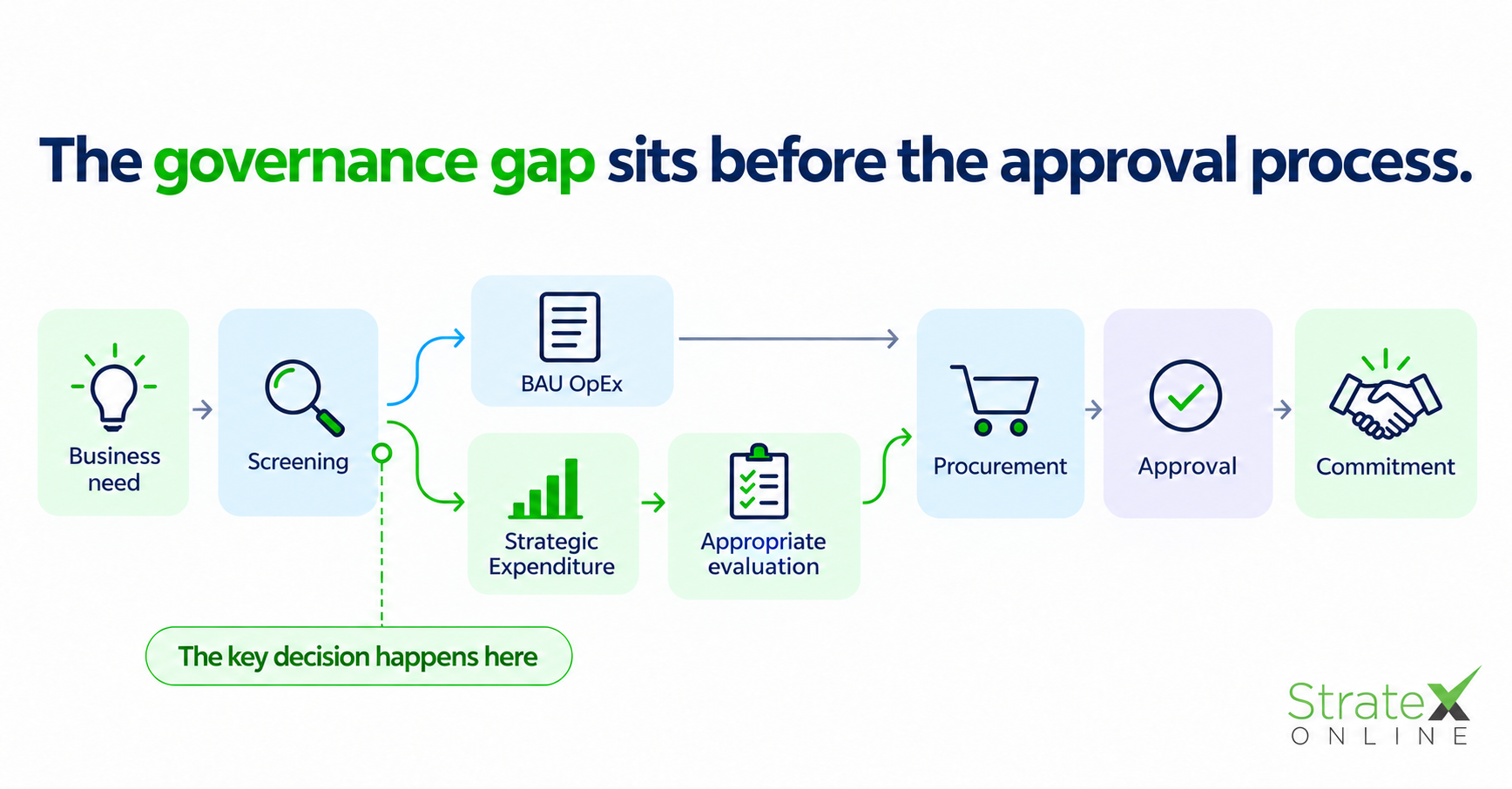
Established processes can also outlive the conditions they were designed for. As organizations grow in size and complexity, the assumptions built into those processes may no longer match the decisions now passing through them.
Why Single Transactions Hide Strategic OpEx Decision Quality
It is difficult for managers reviewing individual purchase orders to identify duplication or poor prioritization, because both are patterns across commitments. A more effective governance process brings all qualifying commitments into view so they can be analyzed together. That comparison can reveal three issues a single transaction cannot.
- Duplication: Two functions solve the same problem separately, using different suppliers, contracts or platforms. A team may also commit to something the organization is already replacing. Each transaction can be authorized, affordable and reasonable when viewed alone. The duplication only becomes visible when the decisions are seen together.
- Suboptimal Allocation: Individual budget holders make choices within the funds available to them. Across the organization, those same funds might have produced a better outcome if requirements, options or budgets had been considered together. The result can still be a poor use of funds, even when each individual decision made sense.
- Unassessed Exposure: Security, regulatory obligations, supplier dependence, business continuity and change impacts do not necessarily show up in the financial value of a transaction. A purchase order can confirm the supplier, amount, budget and account code without showing whether those wider implications were considered before the commitment was made.
These are properties of the Strategic Expenditure portfolio rather than of a single transaction. They emerge from the relationship between decisions: where needs overlap, where funds compete, where one commitment changes the context for another, and whether Strategic OpEx is reinforcing the organization’s long-term priorities or being committed independently across functions.
The financial consequence is not necessarily overspend. An organization can remain within budget while duplication, competing priorities and unassessed exposure reduce the value obtained from that spend. The effect may only become visible later, in forecasts, performance reviews or downstream outcomes. Seeing these patterns means evaluating strategic projects on consistent criteria, so competing requests are ranked together rather than approved one at a time.
What Better Strategic OpEx Governance Adds to Approval Processes
Better governance adds two things to an otherwise valid approval process: greater confidence before commitment and defensibility afterward. Not every OpEx commitment needs investment evaluation, and not every Strategic OpEx decision needs the same level of scrutiny. Which commitments warrant a closer look, and how much evaluation is appropriate, is covered separately in our article, How Do You Evaluate Strategic Projects.
Where closer evaluation is appropriate, it gives decision-makers two things: confidence before commitment and defensibility afterward.
Before commitment, that confidence comes from knowing the level of scrutiny was appropriate to the significance of the decision. It does not mean certainty about the outcome.
Afterward, there is a record of how the decision was reached. Not every investment will deliver the expected outcome, even when the decision was sound. Being able to show what was known at the time and why the choice was made makes the decision easier to understand and explain later. It also creates a basis for learning from the outcome and improving future decisions.
That record is also a financial baseline: what the commitment was expected to cost, what value or savings were anticipated, over what period, and on what assumptions. When forecasts move or outcomes diverge, finance managers have something to compare against rather than reconstructing the original expectation from transaction history, correspondence or recollection.
For regulated organizations, or those accountable to boards, investors, auditors or other external stakeholders, that defensibility can be as important as the eventual outcome.
Keep Strategic OpEx Governance Proportionate
Governance has to stay proportionate because additional evaluation carries a real cost. It uses management attention, adds elapsed time and creates administrative work. In operating expenditure, where decisions are often made close to the business, friction matters.
More scrutiny is therefore not automatically better governance. The value comes from applying enough evaluation to improve the quality of a significant decision without turning routine expenditure into an investment process.
Proportionality is the constraint. The additional confidence and defensibility gained from evaluation need to justify the time and effort required to produce them.
That also makes the burden created by governance part of its effectiveness. A process that improves visibility but consumes disproportionate management time has simply moved the problem. Both decision quality and the effort required to reach a decision are part of effective governance and need to be optimized together.
How to Govern Strategic OpEx Across Functions
Finance leaders may help define when expenditure warrants closer evaluation, but the decisions themselves sit across the business. Strategic OpEx can originate in technology, operations, marketing, HR, procurement or other functions, often within budgets those teams already have authority to spend.
Accountability for a single commitment is distributed. A business function owns the budget. Procurement owns the contract. An executive approves the commitment. Finance is accountable for the forecast and financial outcome. Each participant must contribute to the decision before it is made, which is why this cannot operate as a finance-only procedure.
Finance can provide the framework, but making that framework part of how the organization makes significant spending decisions requires authority across those functional boundaries.
Executive sponsorship provides that authority. It also helps maintain proportionality when individual functions have different views of where additional scrutiny adds value.
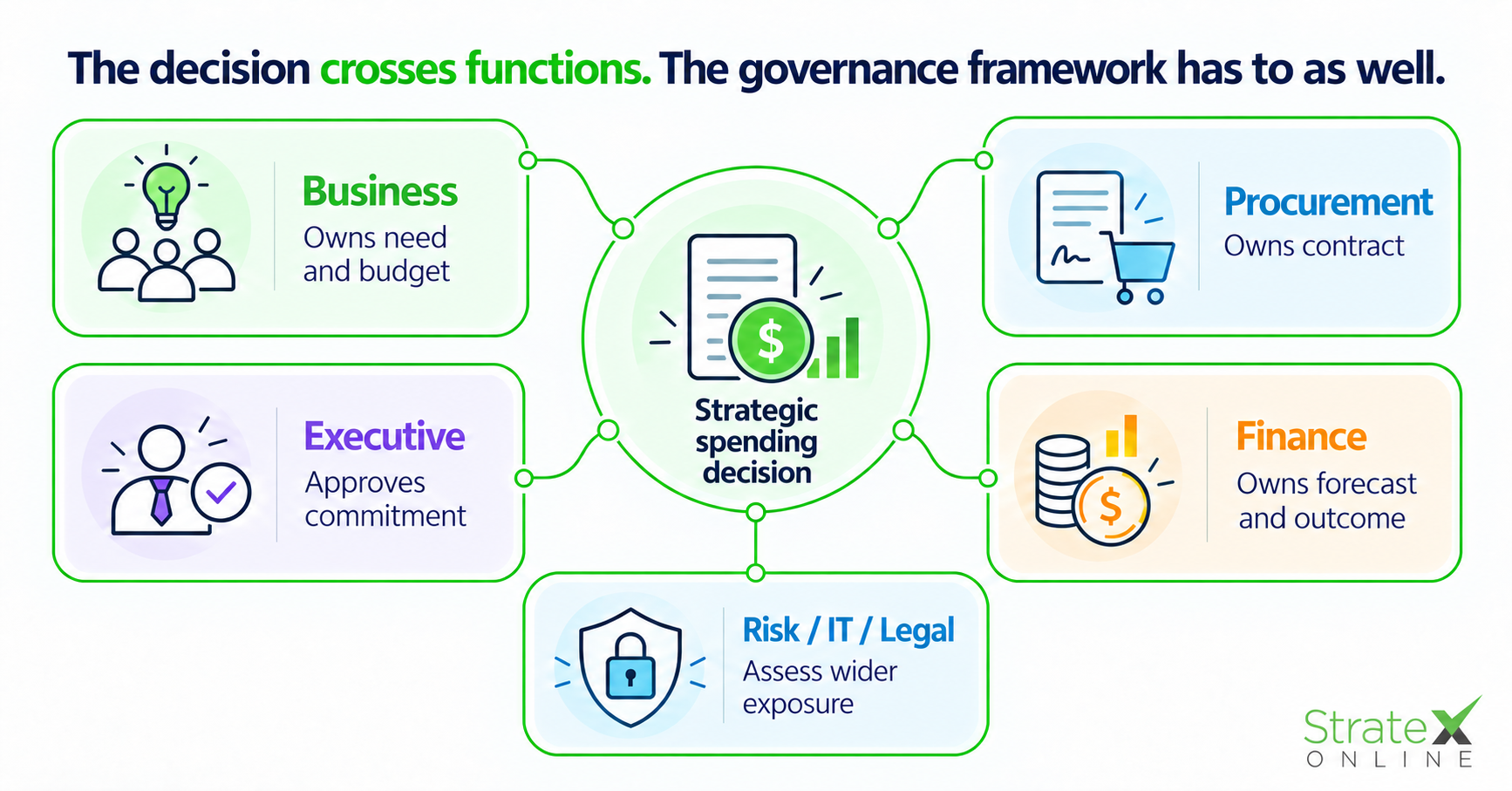
Without that cross-functional authority, the existing route remains the path of least resistance. The issue is unlikely to be an explicit rejection of governance; the additional discipline can simply remain peripheral to the way decisions are made.
Used as a common intake and screening point for project and non-BAU requests, Stratex Online helps identify both CapEx and Strategic OpEx before they move through the appropriate approval process.