

In this article
In this article
If you are evaluating strategic portfolio management software (SPM), most of the platforms on your shortlist will look alike on the things that demonstrate well: strategy alignment, prioritization, portfolio roadmaps, resource capacity, dashboards, and executive reporting. Those capabilities matter. They help an organization decide what to pursue, connect initiatives to strategic objectives, and understand how delivery is progressing, but they may not be what ultimately decides the outcome.
Every strategic initiative is also an investment decision. Whether the organization is funding infrastructure, asset replacement, AI, digital transformation, regulatory compliance, sustainability or an acquisition, each initiative consumes limited funding, delivery capacity, and management attention. The expenditure may be CapEx, OpEx or a combination of both. In every case, the organization must decide what is being proposed, why it should be funded and what it may displace. It must then track what has been approved, committed, and spent, what the latest forecast shows, and whether funding should continue, change or be redirected.
That is financial depth, and it is where the SPM category is thinner. Before selecting strategic portfolio management software by default, it is worth asking whether a dedicated capital investment platform, one that manages both CapEx and strategic OpEx within a single portfolio view, would give you a stronger foundation.
Strategic Portfolio Management Surfaced a Real Problem, but Answers Only Part of It
Strategic portfolio management has helped bring overdue attention to a problem organizations have wrestled with for years: too many initiatives, weak prioritization, and little visibility of whether funding actually follows strategy. SPM software responds by helping organizations capture demand, prioritize competing proposals, allocate funding, model scenarios, manage roadmaps and track delivery. That shift, from managing projects one at a time to managing the portfolio as a whole, is a genuine advance, and modern platforms increasingly reach into business cases and benefits tracking too.
But identifying the right initiatives and aligning them to strategy does not, by itself, govern the money behind them. The deeper question is whether the platform can control that expenditure with the financial depth and discipline the organization needs. That is a different problem from the one SPM was built to solve.
Every Strategic Portfolio is Also a Financial Portfolio
A portfolio can be described through objectives, themes, programs, products, and roadmaps. It is also, unavoidably, a portfolio of financial commitments. Approving one initiative may mean delaying another. Continuing an underperforming program ties up funding that could go somewhere more valuable. An unreliable forecast distorts both the current plan and the next round of decisions. So the organization needs to see more than its portfolio of work; it needs to see its portfolio of strategic expenditure, from plant and infrastructure to digital transformation, enterprise systems, regulatory programs, product development, and major operational improvement.
These initiatives can look very different in delivery terms while looking very similar from a financial perspective: why this investment, why now, how much, what was approved, what is the current forecast, and did it deliver? A portfolio platform must do more than show that an initiative supports strategy. It must help govern the investment behind it.
Allocating Funding is Not the Same as Governing an Investment
Many SPM platforms let you allocate budgets to initiatives, compare scenarios and monitor costs. That is useful, but assigning funding to an initiative is not the same as governing its financial lifecycle. Investment stakeholders often need to distinguish between proposed, planned, allocated, approved, authorized, committed, and actual expenditure, alongside remaining forecast, estimate to complete and forecast at completion. These are not interchangeable numbers. Take a single initiative:
- initial estimate: $15 million
- approved budget: $18 million
- purchase commitments: $12 million
- actual expenditure to date: $7 million
- current forecast: $21 million
A platform that shows only budget and actual cost cannot explain that picture. Why has the forecast risen to $21 million? Is further approval required? How much future cash is needed, and is the funding still available? What has already been committed, and does the original business case still hold? Answering those questions is not project reporting. It is investment governance.
What Financial Depth and Accountability Looks Like
Financial depth does not mean bolting a few cost fields onto a project record. It means treating each initiative as an investment object with a controlled financial lifecycle: from multi-year investment planning and a structured business case, through approval and funding control, into forecasting, procurement, and on to asset capitalization, post-investment review and benefit validation.
That depth matters because Finance carries critical accountability for the integrity of the investment plan, affordability, approval authority, forecast reliability, expenditure governance and the organization’s ability to demonstrate value from strategic expenditure. Finance’s accountability does not diminish the responsibilities of engineers, operations, sponsors, portfolio teams, delivery teams, and procurement, each of whom owns critical decisions and outcomes across the investment lifecycle. The platform must bring these accountabilities together in a way that allows Finance to meet its obligations without reconstructing the true investment position elsewhere.
A platform can offer excellent strategic and delivery visibility and still leave Finance to reconstruct the true investment position in spreadsheets elsewhere. The useful test is simple: does the platform create a shared investment environment for Finance, engineering, operations, strategy and delivery, or a delivery portfolio that Finance has to reconcile somewhere else afterward?
A general SPM platform may support some, even many, of these. The real test is whether they are native to the platform’s design or whether they depend on heavy configuration, bolt-on tools, and spreadsheet controls. Technical configurability is not the same as native financial depth.
Capital Efficiency is the Real Measure, Not Delivery Status
Underneath most of the questions Finance asks sits a single concern: capital efficiency, or how effectively the organization converts scarce funding into strategic, financial, and operational value. That does not mean every investment must show a conventional return. Safety, compliance, or resilience investments are essential precisely because they mitigate risk rather than generating revenue. The principle holds regardless: is funding going to the right investments, being deployed effectively, and delivering the expected outcome?
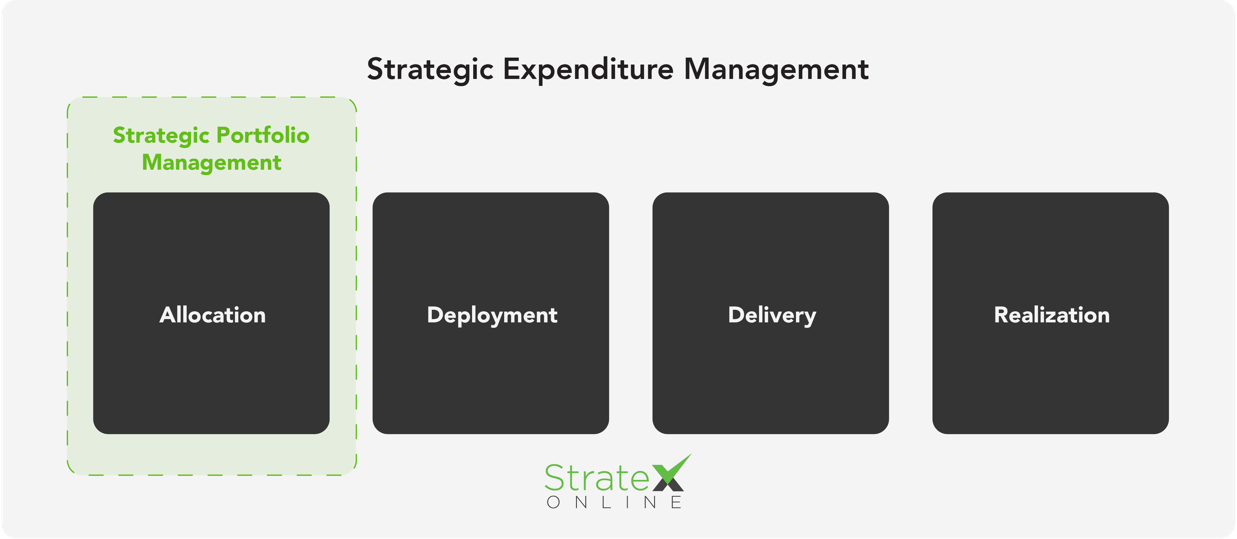
Capital efficiency can be viewed across four stages. Allocation considers whether funding is reaching the highest-priority investments and how much demand remains unfunded. Deployment looks at how quickly approved funding is committed and spent, and how much is tied up in stalled work. Delivery tests whether each initiative remains within the cost, schedule, and benefits case that secured approval. Realization then measures whether the resulting capability or asset became operational and delivered the expected value. Strategic alignment and delivery status are part of this picture, but they are not enough on their own. A portfolio can appear healthy while capital sits undeployed, forecasts deteriorate and benefits never arrive.
The relationship between Strategic Portfolio Management and Strategic Expenditure Management (StratEx) is outlined below:
This is why the business case remains the anchor for capital efficiency. The business case and embedded financial analysis should explain why an investment is needed, why now, what alternatives were considered, what value or risk reduction it will deliver, and who owns delivery and benefits. Those commitments should remain embedded in the investment record and actively tracked after approval, so actual cost, progress and outcomes can be tested against the case. Otherwise, approval becomes a one-off decision rather than the start of an accountable investment lifecycle.
Why a Dedicated CapEx Platform is the Stronger Foundation
A strategic expenditure management platform starts from a different center of gravity. Where strategic portfolio management begins with strategy, priorities, capacity and work, strategic expenditure management begins with demand, business cases, funding, approval, and financial accountability. That starting point pays off when an organization needs rigorous control over significant, complex, or long-running investments.
The important caveat is that a modern capital platform should not be limited to physical assets, because accounting treatment should not decide whether an initiative gets disciplined governance. An AI program may be largely OpEx; a transformation may mix both; a regulatory program may show no conventional return, yet all still need a defensible business case, funding control, delegated approval, periodic forecasting, and post-investment review. The stronger alternative to a general SPM tool is therefore not a narrow capital-budgeting system. It is capital planning with the financial depth of capital investment management, applied across every kind of strategic expenditure within one consolidated portfolio. The portfolio view should be broad; the financial governance beneath it should be deep.
The categories are converging. SPM vendors are adding financial capability, and capital platforms are adding strategy and scenario planning, so the label matters less than where the operating model begins. A tool designed around work will rarely reach the financial depth of one designed around expenditure and investment governance. Set side by side, the difference in emphasis is clear:
| Strategic Portfolio Management | Strategic Expenditure Management |
|---|---|
| Align to Strategic Direction | Deliver Strategic Outcomes |
| What to do | Where to invest |
| Prioritizes initiatives | Governs investment decisions |
| Emphasizes roadmaps, capacity, and delivery | Emphasizes funding, approvals, forecasts, and value |
| Allocates funding periodically | Controls approved, committed, spent, and forecast expenditure continuously |
| Tracks portfolio progress | Connects financial and delivery performance |
| Supports business cases | Maintains the business cases |
| Projects qualitative benefits | Forecasts long-term financial impact |
| Provides a portfolio of strategic work | Provides a portfolio of CapEx and strategic OpEx |
| Supports project portfolio management | Supports integrated business planning |
Capital-intensive Organizations Face the Deepest Test
The need for financial depth applies across every industry, but it is most visible in capital-intensive ones. Mining, energy, utilities, manufacturing, transport, and infrastructure businesses run large portfolios of replacement and sustaining capital, growth projects, compliance investments, shutdowns, and major maintenance. These often span years and involve complex engineering estimates, procurement commitments, cash-flow profiles, staged approvals, and phased capitalizations. These projects are governed through AFE, CAR, CER, or PAR processes, and require contingency and work-in-progress tracking.
For these organizations, the gap between narrow SPM capability and deep capital governance is at its widest. A general SPM platform may still add value on strategy and delivery, but a dedicated investment platform usually delivers substantially more to Finance, engineering, operations, and executive leadership.
Choosing Strategic Portfolio Management Software
The danger with SPM is that the evaluation gets decided on what demonstrates well (strategy maps, scoring, roadmaps and dashboards) while the harder financial questions surface only after implementation, when the financial analysis still lives in spreadsheets, funding cannot be reconciled with the latest forecast, and executives still lack a trusted view of total strategic expenditure. Weigh each platform against the requirements that matter once the roadmap demo is over:
- Investment planning: Can it manage annual and multi-year plans, control funding by unit, category, priority and financial year, hold CapEx and strategic OpEx in one portfolio, compare scenarios, and rank unfunded demand?
- Business cases: Can a case be captured before a project exists, use different criteria for different investment types, standardize assumptions, consistently calculate key financial metrics, and stay connected to later delivery and benefits?
- Approval and governance: Can approval routes reflect delegated financial authority, separate funding approval from project approval, apply conditions and expiry, and trigger reapproval on material change?
- Forecasting and financial control: Can it distinguish proposed, approved, committed, spent, and forecast expenditure, maintain forecasts, show future P&L and Balance Sheet impact, and integrate with ERP commitments and actuals?
- Cross-functional participation: Can engineers, operations, delivery and sponsors all work in the same governance process without being forced into finance-only templates?
- Benefits and outcomes: Can expected benefits be linked to the approved case, tracked beyond completion, and used to stop, redirect, or inform future funding?
When the honest answers require extensive customization, separate tools or spreadsheet workarounds, you are asking a general SPM platform to do the job of a dedicated strategic expenditure management system.
How Stratex Online Approaches Strategic Portfolio Management
Stratex Online is a SaaS solution that combines SPM with strategic expenditure management to maximize your return on capital employed. Stratex Online brings CapEx and strategic OpEx into one portfolio while retaining the controls needed to govern each investment from initial demand through business case, evaluation, prioritization, funding, approval, forecasting, delivery, expenditure, post-investment review, and benefits realization.
The aim is to provide executive management, finance, engineering, and operations one shared system of record for prioritizing and managing strategic expenditure. Stratex Online retains the strategic portfolio view of SPM while gaining the financial depth to manage how investments are justified, approved, controlled and turned into value. For organizations with significant strategic expenditure, this combination of broad portfolio visibility with finance-grade control provides the stronger foundation a general SPM platform alone cannot match.