

In this article
In this article
A capital project can finish inside its supplemented budget, on its revised schedule and to the refined scope, and yet still fail to produce the expected result. Project success does not always mean business success. Delays and deferred benefits are often justified along the way by the project office but are rarely simultaneously reflected in the integrated business plan. The cost is real, whether it shows up as actual spend or as opportunity forgone.
Integrated business planning is the rolling, cross-functional process that produces the whole-of-business plan, with the Financial Planning and Analysis (FP&A) team often facilitating the process and consolidating the financial outlook. In many organizations the capital plan feeds into this plan only once: the investment cost, the asset values and the expected returns all cross over at budget time, and then the plan reflects them unchanged while the project itself evolves.
So when a project runs late, or costs more, or is re-scoped, the integrated business plan built around the original commissioning date and benefits may not be revisited, because nothing links the two. By the time the delay is communicated, the business may have already committed costs: resources may have been hired, leases commenced, inventory bought and market announcements made targeting a date that no longer holds.
This article covers where the handover between the capital investment plan and the integrated business plan breaks down, and what it costs when it does. A six-month delay can leave a project’s own business case still looking healthy while the wider business absorbs a cost more than double what the capital model shows.
Capital Projects and 5 Verdicts on Success
A capital project delivered to its revised schedule, budget and scope can be judged a success by four functions and a failure by the fifth. Ask five people whether it succeeded and all five answers are correct:
- Project Manager: “We successfully delivered to schedule, budget, and scope (in accordance with agreed change requests!).”
- Project Portfolio Manager: “The project was closed out successfully and portfolio reporting shows it was delivered as planned.”
- CapEx Controller: “Overall the capital program stayed within the latest approved funding and forecast.”
- Engineering: “We accepted the technical outcome, including the compromises and change requests approved along the way.”
- Business Unit Manager: “The project was a disaster, as we missed the revenue growth and cost savings that justified the investment in the first place.”
Four of those verdicts are measured against the plan as it was last revised. The fifth is measured against the business outcome the investment was approved to produce, and it is the only one nobody adjusted along the way.
That is an integrated business planning failure rather than a project delivery failure, and it stays invisible because every function reported accurately against what it was asked to measure.
None of this is hidden inside the capital process. Revised schedules, re-forecast cash flows and updated returns are exactly what CapEx management analytics exists to surface. Seeing a change in the capital report is a different thing from propagating it into the plan that was built around the original date.
What Integrated Business Planning Is and Where Capital Planning Fits
Integrated business planning is a cross-functional planning and decision process that aligns strategy, demand, supply, workforce, operations and financial outcomes across a rolling 24-to-36-month horizon. It grew out of sales and operations planning and extended it in three directions: wider scope, a longer horizon, and a direct link to strategy.
FP&A usually facilitates the process and consolidates the P&L, balance sheet and cash flow outlook. Executive leadership collectively owns the resulting plan, and for listed companies it may also inform market guidance.
Capital planning feeds that process, with growth and savings initiatives factored into profitability forecasts. The problem is that the impact of the capital plan is exchanged only once, and often only at a high level.
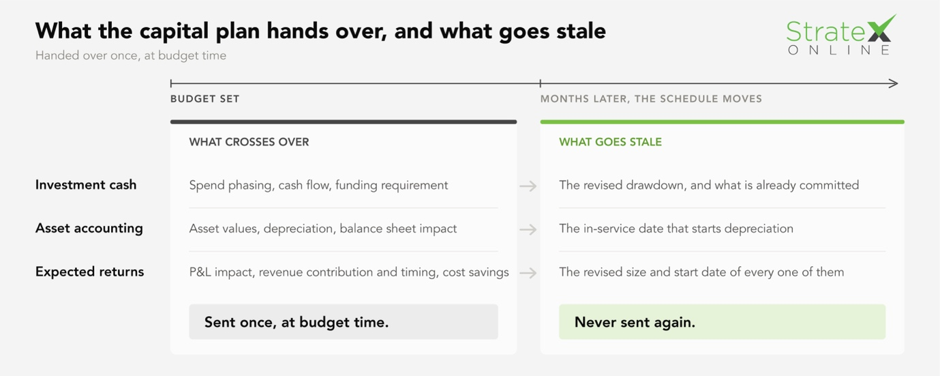
The capital plan crosses into the integrated business plan once, at budget time. What changes afterwards never makes the same trip: a revised drawdown, a moved in-service date, the size and start date of every expected return.
Furthermore, some critical capital planning information is not exchanged at all: capacity and throughput assumptions, schedule risk and the dependencies keyed to it, sensitivity ranges and contingencies, internal resource and supplier dependencies, and the effect of substituting one project for another.
Integrated business planning aligns demand, supply, workforce and financial plans on a common set of assumptions. The connection to capital planning breaks when capital projects enter that plan as expenditure and asset forecasts, while the revenue and cost changes tied to their delivery dates are maintained in separate systems, on a different cycle.
Alignment between the capital plan and the integrated business plan is therefore at its strongest the day the budget is set. It decays from there, because what the integrated business plan rarely picks up is everything that happens next.
And something always happens next. Schedule slippage is the most common movement, arising from procurement and contracting, permitting and environmental approvals, internal approvals and set-up, infrastructure dependencies and supplier availability. Budgets move too, through periodic underspend where the schedule slips and cumulative overspend where technical complexity, un-scoped requirements, cost inflation, freight and tariffs, or input availability compound. Benefit assumptions move as well, through re-phasing and re-prioritization, revised labor rates, changed market share or pricing power, and adjustments to how long a saving runs or how much volume a new line actually produces.
In a dynamic operating environment, whether regulatory, competitive, technological or geopolitical, delivering a complex capital program precisely to plan is impossible. It is also undesirable. Conditions change, and a portfolio should be re-prioritized when they do.
Plans changing is normal. The difficulty is that when business cases sit outside the integrated business planning process, each one can still stand up on its own while the interdependencies and combined consequences go unrecognized until much later.
Where the Capital Plan Is Also the Revenue Plan
Exposure to capital project delay depends on how much of an organization’s forecast revenue rests on assets that are not yet running. Where revenue or savings depend on capacity that has to be commissioned first, the capital plan is also part of the revenue plan.
For example, in mining, revenue is close to directly proportional to investment in extraction. A new shaft and the tonnage it is expected to produce is effectively the sales plan. In manufacturing and processing, production output is linked to equipment capacity and operational efficiency, and a production line that commissions late strands the hiring and the inventory built around it. In professional services, the digital and automation programs that promised productivity and revenue growth rely on the new IT systems delivering the expected benefits on a planned date. The revenue of frontier model providers is directly proportionate to the availability of data centers and chips.
Organizations with a large installed capital base may be less exposed, because any single upgrade or extension is a smaller share of the forecast. Less exposed is not unexposed.
The question is one of proportion. The more your forecast depends on assets that are not yet running, the more dependent your integrated business plan is on the capital program delivery date projections.
Why FP&A Reports the Investment but Not Its Full Operating Variations
FP&A is asked to produce a P&L, balance sheet and cash flow forecast for the whole business. For capital, that requires timing and classification. When the money goes out, what gets capitalized, what depreciates and over what period. Those are inputs a planning team can obtain for every project in the portfolio, on a repeatable cycle, in a consistent format. It is the right ask, and it is answerable.
The substance of the projects sits somewhere else. Engineering, operations, HR and procurement sponsored them. They know what the investment is meant to change, what has to hold for that change to happen, and which date it depends on.
That detail doesn’t exist in a standardized format in an accessible place. It was captured during business case evaluation, in per-business-unit formats, as documents rather than as structured data. How that plays out inside the capital process itself is a separate problem, covered in closing the FP&A gap for capital project control. The point here is narrower. A business case can be complete, rigorous and correct, and still be unusable as a planning input, because a planning team cannot consume dozens of documents at portfolio scale on a monthly cycle.
So the handoff carries what is readily usable: investment cash flows, asset balances, depreciation, and the original benefit assumptions as they were approved. What it leaves behind is every subsequent change to those benefits. Which are the critical numbers the business unit manager is measured on.
Nobody designed it that way. It is a scope boundary that was drawn sensibly and has never been redrawn.
The Same Benefit Assumption Lives in Two Plans
The integrated business plan is usually not missing the benefit at all. The headcount reduction, the throughput increase, the revenue from the new market: it is already there. Somebody put it there. A department head building next year’s budget knew the automation project was landing in Q3 and took the roles out. A sales director knew the new line was commissioning in Q2 and projected the volume increases. None of them read those numbers out of the capital system. They entered them by hand, in a different cycle, against a commissioning date they were given at the time.
So the same assumption now exists twice. Once in the business case, where the sponsor owns it and re-evaluates it when the schedule moves. Once in the integrated business plan, where a line manager owns it and treats it as settled. Both are maintained. Neither is automatically connected to the other.
This is not double-counting. The number appears once in the consolidated forecast, as it should. It is duplicate authorship without reconciliation, which is quieter and harder to see. When the capital planner re-phases, nothing tells the integrated business planner to follow, because there is no single source of planning assumptions and projections shared by both areas.
Whether the benefit was eventually realized is a separate question, tracked properly through capital analytics. The failure here happens earlier, and it happens because one copy is written as narrative inside a business case while the other is entered as a line in next year’s budget, and no process was built to hold them together.
The Delay the Project Survives and the Business Plan Does Not
A six-month delay produces two different answers depending on which model you run it through. Both are calculated correctly. Only one of them gets reported.
The Illustrative Project
A new production line. Capital cost $18M spread evenly across a 12 month build. Incremental pre-tax operating cash flow of $4.2M a year over a 10 year asset life, starting at commissioning. Discount rate 10 percent effective annual, compounded monthly, with cash flows at month end. Investment hurdle is 15 percent. Tax, working capital, sustaining capital and residual value are excluded to keep the mechanism visible.
On plan, that project returns NPV of $7.42M at an IRR of 19.4 percent.
The Project View of a 6-month Delay
Two simplified cases, because the answer depends on how much spend has already gone out the door.
| Case | Mechanism | NPV | Change | IRR |
|---|---|---|---|---|
| Base | Commissioned on plan | $7.42M | – | 19.4% |
| Nothing yet committed | Costs and benefits both shift six months | $7.07M | down 4.7% | 19.4% |
| Committed spend case | Investment cash flows remain in place; benefits shift six months | $6.28M | down 15.4% | 17.1% |
The first case is the best outcome available. If nothing has been committed, every cash flow shifts by the same six months, so the IRR does not move at all and NPV loses only the discounting.
The second case is the realistic one, and on most projects it is closer to what has actually happened. Contracts are awarded, equipment is on order, committed expenditure is already locked in against the original schedule. The money leaves on time. The returns do not arrive on time.
Even so, the numbers hold. NPV falls by $1.14M. IRR falls from 19.4 to 17.1 percent, still clear of the 15 percent hurdle. The project remains a project worth doing.
The steering committee that accepts that revised schedule is reading its model correctly and reaching a defensible conclusion. Nobody in the room is behaving badly. The model they are looking at simply does not contain the rest of the answer.
The Business View of the Same 6 Months
The commitments other functions made against the original commissioning date. Illustrative figures, structurally scaled to an $18M line:
| Commitment | Cost |
|---|---|
| Operators recruited ahead of commissioning, then idle | $0.6M |
| Facility lease commenced, rates and services payable | $0.35M |
| Inventory carrying, storage and write-down costs | $0.4M |
| Launch marketing and channel spend committed, then re-run | $0.5M |
| Take-or-pay, cancellation or minimum volume charges | $0.6M |
| Total | $2.45M |
The project model shows $1.14M of NPV erosion in the committed spend case. The commitments already made against the original date come to roughly $2.45M, more than double, and none of it appears anywhere in that model.
Nor does it appear in one place afterwards. It is dispersed across operating budgets as a variance here and an accrual there, each one explained locally and none of them tagged to the schedule change that caused them. The capital report shows a project that slipped and still cleared its hurdle. That report is accurate.
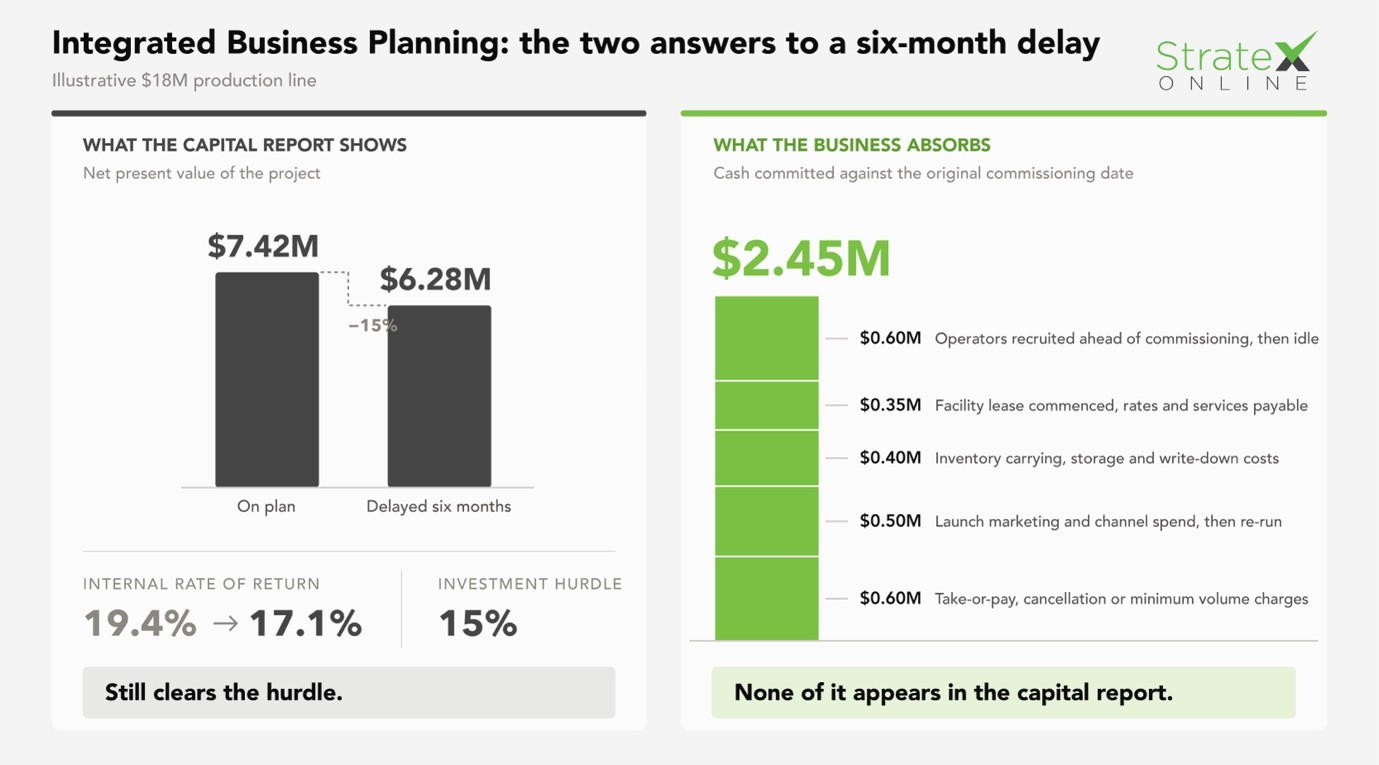
A six-month delay on an $18M production line. The capital report still clears its hurdle at 17.1% IRR, while the $2.45M already committed against the original date lands somewhere else entirely.
None of this is an argument against the project metrics. NPV and IRR each answer a real question about the investment, and on this project both answered it correctly. Neither is asking what the rest of the business committed to, or when.
Why Better Project Schedules Do Not Reforecast the Business Plan
The usual first response to capital schedule slippage is to fix the schedule. Honest dates, real contingency, reference-class forecasting instead of intent. Estimating improves and dates move less often.
They still move. A tie-in window closes, a vendor slips, a regulatory approval takes a quarter longer, a commissioning fault surfaces in week three. Capital schedules carry uncertainty that no estimating method removes, and across a portfolio of any size some movement is normal rather than exceptional.
A conservative date is still a date. Whatever schedule gets published is the one other functions hire, lease and contract against, so a padded date that slips lands the same way an optimistic one does. The buffer protects the project. It does not protect the plan.
Better estimating changes how often the date moves. It does not change what happens downstream when it does.
Connecting Capital Planning with Integrated Business Planning
Connecting the capital plan to the integrated business plan takes three things: benefits held as data, benefit phasing sent alongside spend phasing, and something that fires when a date moves.
What the Capital Plan Has to Hold
A benefit that exists only as narrative inside a business case cannot be re-phased, because there is nothing to re-phase. Making it moveable means holding it as data.
That means one financial model across every business case rather than one per author, so the portfolio can be queried rather than read. Benefit components held separately and quantified: revenue uplift, cost savings, headcount, capacity. And each of them carrying its own start date, keyed to the project schedule rather than to the fiscal year, because the fiscal year does not move when a commissioning date does.
Horizon matters here too. The business case runs the whole asset life, ten years or more. Integrated business planning capital projects often runs 24-36 months. What the integrated business plan needs is the slice of those time-phased benefits that falls inside its own horizon, which is only calculable if the benefits are phased in the first place.
What the Planning Process Has to Receive
Today the handover carries spend phasing by period. That is one half of the capital plan.
The other half is benefit phasing by period: expected revenue contribution and cost savings across the approved portfolio, on the same cadence and in the same format as the spend forecast. Benefit phasing is what turns the capital plan from a cost line into a planning input. It is also the number that moves when a schedule moves, and the one most organizations do not routinely send.
What Has to Happen When a Date Moves
Structure and transmission still leave the hardest part. A revised forecast that arrives without saying what changed puts the work of finding the change onto whoever receives it.
The signal is a delta, not a report. Which benefit lines moved, by how much, and to when, measured against the phasing last published.
Around that sit four things. A trigger and an owner, firing on a change to a commissioning or benefit-start date, alongside the process that already exists for changes to spend. An addressee for every benefit type, so revenue reaches the sales plan, cost savings the operating plan, headcount the workforce plan and capacity the supply plan, each with a named person expected to act on it. A fixed cadence, predictable enough that other functions can rely on it, with material exceptions escalated sooner when waiting would remove the ability to act.
And a forum for the schedule-versus-budget decision with all the numbers at hand. At 17.1 percent IRR the project cleared its hurdle on its own terms. The forum had nothing else to evaluate the impact.
Where Stratex Online Fits
Stratex Online holds business case financial analysis in one shared repository rather than across individual documents, with benefit components classified consistently so they can be compared across projects. Each benefit carries its own start date, linked to the project activity that delivers it, so a change to delivery duration re-phases the associated returns rather than leaving them where they were. Budget supplements, schedule and cash flow re-forecasts, and variances in both benefit quantum and benefit timing sit in the same place. Benefit phasing can be reported by period across the portfolio, on the same cadence as the spend forecast.
More on how that works in project forecasting and analysis.
Capital Planning as a Control Point in Integrated Business Planning
The gap between the capital plan and the integrated business plan is narrow and specific. It is not a strategy problem. It is a missing link between a date held in one system and a set of numbers held in another.
Close it and the change is immediate. A schedule that moves in month four becomes a decision in month four rather than a variance explained in month nine. Hiring can be deferred rather than absorbed. A lease can be renegotiated while there is still time to renegotiate it. Crews and capital can move to the project that is actually ready. And the trade-off that protects the most value, spending more to hold a commissioning date because the market window is worth more than the overrun, becomes an argument somebody can make with numbers behind it.
That is where the competitive difference sits, and it is why capital timing has become a question for CFOs managing capital expenditure rather than one left to the project office. Two companies can run the same portfolio with the same slippage. The one whose integrated business plan reforecasts when a date moves makes fewer commitments it later has to unwind, and defends the launch dates that matter.
The first move is small. Most planning teams cannot say which numbers in the plan they are carrying depend on an asset that is not yet running, or which dates those numbers are keyed to. How hard that question is to answer tells you most of what you need to know.