

In this article
- What Is Strategic Budgeting?
- The Strategic Budgeting Process
- Why Strategic Budgeting Is Becoming More Complex
- What Strategic Expenditure Means in the Strategic Budgeting Process
- How Strategic Budgeting Links to Strategic Expenditure
- Strategic Budgeting Should Separate BAU from Strategic Spend
- What Good Strategic Budgeting Should Enable
- From Strategic Budget to Strategic Expenditure Governance
- How Stratex Online Supports Strategic Budgeting and Strategic Expenditure Management
- Strategic Budgeting is the Starting Point, Not the Whole System
- FAQ on Strategic Budgeting
In this article
- What Is Strategic Budgeting?
- The Strategic Budgeting Process
- Why Strategic Budgeting Is Becoming More Complex
- What Strategic Expenditure Means in the Strategic Budgeting Process
- How Strategic Budgeting Links to Strategic Expenditure
- Strategic Budgeting Should Separate BAU from Strategic Spend
- What Good Strategic Budgeting Should Enable
- From Strategic Budget to Strategic Expenditure Governance
- How Stratex Online Supports Strategic Budgeting and Strategic Expenditure Management
- Strategic Budgeting is the Starting Point, Not the Whole System
- FAQ on Strategic Budgeting
Strategic budgeting connects financial planning to strategy. The challenge is deciding which initiatives deserve funding, who governs those decisions, and how control is maintained once initiatives move from planning to execution.
This is becoming more important as strategic investment is no longer just controlled via the capital budget. Fixed asset investments, SaaS platforms, and AI transformation programs now all compete for the same funding, resources and executive attention.
From an accounting perspective, this expenditure will be treated as either Capital Expenditure (CapEx) and be capitalized on the balance sheet or Operational Expenditure (OpEx) and hit the bottom-line directly. But from a strategic executive management perspective, this accounting classification is irrelevant. Any strategic expenditure, whether CapEx or OpEx, that consumes significant human and capital resources and will impact future outcomes requires strategic budgeting.
This article looks at what strategic budgeting means, why CapEx and strategic OpEx need to be considered through a common decision framework, and how strategic budgeting fits within the broader discipline of Strategic Expenditure management.
What Is Strategic Budgeting?
Strategic budgeting is the process of allocating financial resources to initiatives that support long-term business goals, typically 3-5 years long. Strategic budgeting combines the practice of financial planning and budgeting to effectively fund the strategic initiatives that drive growth, innovation, and value creation, such as AI projects.
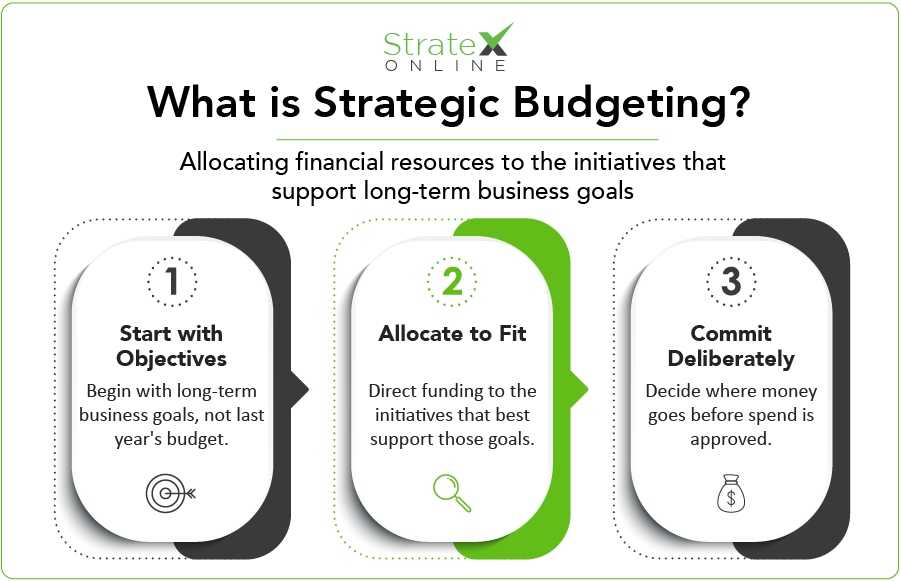
Within strategic expenditure management, strategic budgeting helps organizations decide how funding should be allocated across CapEx projects and strategic OpEx initiatives before spend is approved and committed.
Unlike traditional budgeting, which often starts with last year’s numbers and adjusts them marginally up or down, strategic budgeting starts with business objectives and works backwards to decide where resource should be directed.
The strategic budgeting process addresses the following decisions:
- How to cascade enterprise strategies down through the organization?
- How to structure and align responsibilities for the investment program?
- What proportion of funding should be allocated to growth vs sustenance?
- How to evaluate, score and rank competing initiatives?
- How should resources be allocated across competing priorities?
- What level of investment can the organization support?
- Which initiatives best align with strategic goals?
- Where on the efficient frontier of risk and return do we want to be?
The aim of strategic budgeting is to make funding decisions more deliberate, not to make budgeting more complicated. Strategic budgeting is about deciding where money should go before it is committed.
The Strategic Budgeting Process
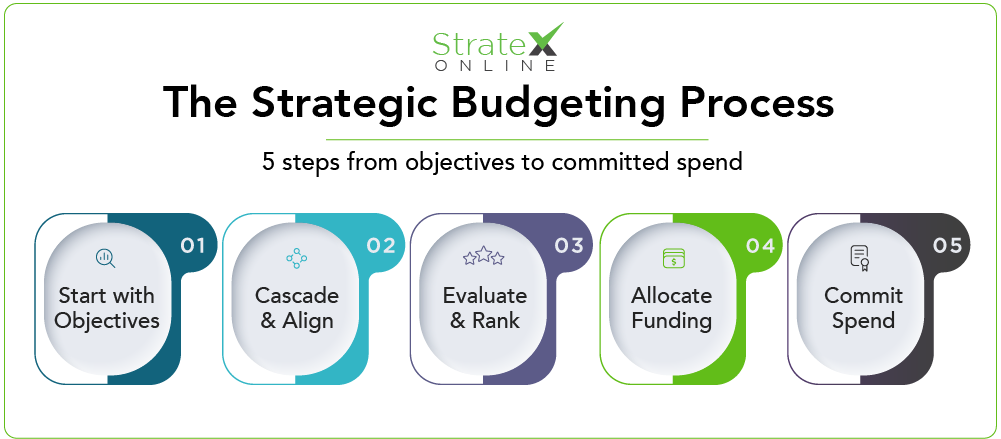
Strategic budgeting turns enterprise strategy into committed spend through five connected steps, each resolving a key set of decisions about where and how the organization invests.
1. Start with Objectives
The process begins with the enterprise strategy itself. This step defines the strategic goals that every investment decision will be measured against, establishing the criteria for which initiatives best align with those goals before any funding is discussed.
2. Cascade & Align
Enterprise strategies are then cascaded down through the organization and responsibilities for the investment program are structured and aligned. This ensures accountability is clear at every level and that each business unit understands how its initiatives connect to the broader strategy.
3. Evaluate & Rank
Competing initiatives are evaluated, scored, and ranked on how well they support the defined objectives. This is also where the organization decides where it wants to sit on the efficient frontier of risk and return, weighing potential upside against acceptable exposure.
4. Allocate Funding
With initiatives ranked, resources are allocated across competing priorities. This step settles the proportion of funding directed to growth versus sustenance and matches the overall program to the level of investment the organization can realistically support.
5. Commit Spend
Finally, the agreed decisions are locked in and spend is committed, directing resources to the priorities that deliver the most strategic value and closing the loop from objectives to funded action.
Why Strategic Budgeting Is Becoming More Complex
Strategic budgeting becomes harder when strategic project demand is dispersed before finance even gets a proper view of it.
CapEx may be planned through a capital budgeting process, asset planning cycle or project portfolio review. Strategic OpEx may appear somewhere else entirely: inside departmental budgets, cost centers, procurement approvals, transformation funding or technology subscriptions.
On paper, these pathways may make sense. Inside the budget cycle they create a fragmented view of strategic demand.
One initiative may arrive with a detailed business case, multi-year cashflow and risk assessment. Another may appear as a software subscription, a consulting engagement or a departmental program with limited scrutiny. Both may be material. Both may affect future capability and success. But they are not always evaluated with the same assumptions, financial models, approval thresholds or governance standards.
The timing of spend makes comparison even harder. Some initiatives require upfront funding. Others create recurring commitments, staged investment decisions or long-term operating costs that do not look significant in year one but become material over time. By the time the full cost is visible, the organization may already be locked into the direction of travel.
Strategic budgeting cannot rely on budget category alone. Whether an initiative is CapEx or OpEx matters for accounting, but is doesn’t tell managers whether all material strategic demand has been seen early enough, compared consistently and prioritized through one decision lens.
A complete view of strategic demand gives finance a stronger basis for enterprise-level funding decisions before partial information becomes locked-in spend.
What Strategic Expenditure Means in the Strategic Budgeting Process
Strategic Expenditure is the material, non-BAU spend an organization directs toward strategic objectives.
In a budgeting context, that definition matters because it changes the organizing principle. The question is less about whether spend is capitalized or expensed, and more about whether the initiative is material, discretionary, non-routine and likely to affect future performance, capability, growth, risk or transformation.
Accounting categories do not always reflect strategic consequence. A relatively small OpEx commitment can become a long-term dependency. A capital project can unlock capability well beyond the asset itself. A program that starts as a departmental initiative can become central to how the organization competes, operates or manages risk.
Strategic Expenditure gives finance and executives a clearer way to identify this class of spend before it is buried inside separate planning cycles, budget lines or approval pathways. It draws attention to the initiatives that need stronger evaluation, more consistent comparison, clearer governance and ongoing forecasting after funding is allocated.
How Strategic Budgeting Links to Strategic Expenditure
Strategic budgeting should be understood as occurring early in the Strategic Expenditure lifecycle, not as a separate finance exercise.
A budget can look strategic at the point of approval and still lose discipline later. Once initiatives move into execution, spend may be managed through disconnected spreadsheets, project tools, procurement workflows or departmental reporting.
The real risk is that the original funding logic gets separated from the way the initiative is delivered, controlled and reviewed.
The table below shows how common strategic budgeting questions connect to Strategic Expenditure management.
| Strategic Budgeting Question | Strategic Expenditure Connection |
|---|---|
| What are our strategic goals and objectives? | Evaluate alignment of all initiatives to these objectives. |
| What is our risk tolerance? | Evaluate the IRR of projects in-line with risk profile and set thresholds and rank accordingly. |
| What are some of the likely environment scenarios that may play out? | What is the sensitivity of our portfolio to potential scenarios? |
| What should receive funding? | Identifies all the potential initiatives that enter the strategic expenditure portfolio. |
| How should funding be prioritized? | Compares CapEx and strategic OpEx based on value, risk, urgency and strategic alignment. |
| What capital and resource constraints do we have? | Tests demand against available funding, resources, timing and delivery capacity. |
| What happens after budget allocation? | Moves selected initiatives into business case evaluation, approval, forecasting and governance. |
| How do decisions stay controlled? | Connects budget decisions to ongoing visibility, portfolio review and reallocation. |
The stronger approach is to make sure the budget decision carries through into business case evaluation, approval, forecasting, portfolio review and reallocation.
That is how organizations move from setting a strategic budget to governing strategic spend.
Strategic Budgeting Should Separate BAU from Strategic Spend
Strategic budgeting does not mean every operating cost needs a business case.
Salaries, rent, utilities and routine operating costs can stay where they belong: inside normal departmental budgeting. These costs still need discipline, but they do not need to be managed through the same evaluation process as a major growth initiative, transformation program or strategic capability investment.
The more useful divide is not CapEx versus OpEx, but Business as Usual (BAU) spend versus strategic spend. BAU spend keeps the organization running, while strategic spend is material, discretionary, non-routine, linked to strategic objectives and often multi-year in impact.
It is also important enough to require governance because the consequences of getting it wrong can extend well beyond the current budget period. That is why a material strategic OpEx initiative may deserve the same level of scrutiny as a CapEx project.
If a spend decision can shape future capability, risk, growth or performance, it should not be waved through simply because it is treated as operating expenditure. It should be assessed on strategic value, priority, risk and resource demand.
Strategic budgeting becomes stronger when it separates routine BAU spend from the initiatives that can genuinely change the organization’s direction.
What Good Strategic Budgeting Should Enable
A strategic budget is only useful if finance and executive teams can see what is competing for funding, how those initiatives compare and whether the organization has the capacity to deliver them.
Here are five practical capabilities a good strategic budgeting process should enable:
A single view of strategic demand
Finance cannot prioritize what it cannot see, which is why strategic budgeting needs to capture material initiatives from across the business, including both CapEx and strategic OpEx. Without that single view, demand remains split across spreadsheets, departmental submissions, project lists and budget conversations, making it harder to understand the true scale of what the organization is trying to fund.
Consistent comparison of initiatives
Once demand is visible, it needs to be assessed using shared criteria. A stronger process gives teams a consistent way to compare value, risk, urgency, confidence and strategic alignment, rather than allowing each department to bring forward requests with different assumptions, different metrics and different levels of scrutiny.
Visibility of funding and resource constraints
Good strategic budgeting also exposes the constraints that shape the decision. Available funding is only one part of the picture; managers also need to understand resource demand, delivery capacity, timing and competing commitments across the portfolio. A project may look attractive in isolation and still be the wrong decision if the organization does not have the people, capital or execution capacity to support it.
Financial modelling and scenario planning
Strategic budgeting should help managers test the financial impact of different choices by modelling cash flow, understanding multi-year implications and comparing portfolio options before decisions are locked in. This becomes especially important when initiatives create staged investment, recurring costs or benefits that take time to materialize.
Clear decisions to fund, defer, scale or stop
Analysis only matters if it leads to a clear decision. A good process should help managers decide which initiatives to fund, defer, scale back or stop based on strategic value, risk, resources and timing, while making those decisions easier to revisit when priorities change, costs move or new opportunities emerge.
Strategic budgeting is stronger when it gives managers a connected view of demand, constraints and trade-offs, rather than a collection of fragmented submissions competing for approval.
From Strategic Budget to Strategic Expenditure Governance
Allocating funding is only the first test of strategic budgeting. The harder test is whether the organization can keep that decision visible, governed and adaptable once initiatives move into evaluation, approval and delivery.
Once money is allocated, the organization still needs a way to move selected initiatives through evaluation, approval, forecasting, monitoring and review without losing the logic behind the original decision. Otherwise, the budget may show what was approved, but not whether the spend is still justified, affordable or aligned to the priorities that secured funding in the first place.
Strategic Expenditure governance connects the funding decision to the stages that follow:
- Demand capture
- Strategic budgeting
- Business case evaluation
- Prioritization and portfolio selection
- Approval and governance
- Forecasting and monitoring
- Outcome review and reallocation
Across that lifecycle, each stage has a specific control job. Demand capture brings potential initiatives into view. Strategic budgeting decides where funding should be directed. Business case evaluation tests the case for investment. Portfolio selection forces comparison across competing priorities. Approval and governance create accountability. Forecasting and monitoring show whether spend and benefits are tracking as expected. Outcome review gives managers the chance to learn, adjust or reallocate.
Disconnected handovers are where strategic intent gets lost. A project may be funded for one reason, approved on a different set of assumptions, forecast in another system and reviewed only after the opportunity to intervene has passed.
Strategic expenditure governance keeps the thread intact. It gives finance and executives a way to see whether funded initiatives are still aligned, still viable and still worth continuing as conditions change.
That is the difference between setting a strategic budget and staying in control of strategic spend.
How Stratex Online Supports Strategic Budgeting and Strategic Expenditure Management
Connecting strategic budgeting to Strategic Expenditure management takes more than a budget spreadsheet. Finance teams need a structured way to keep strategic demand, business cases, funding decisions and forecasts connected as initiatives move through the lifecycle.
Stratex Online supports that shift across four areas.
1. One planning and governance layer
Stratex Online brings CapEx and strategic OpEx initiatives into one planning and governance layer, giving finance teams a central place to capture strategic demand, keep control of supporting documents and maintain visibility across the initiatives competing for funding.
When strategic demand comes from different business units, approval pathways and budget categories, a common layer stops managers from reviewing fragments rather than the full strategic investment picture.
2. Consistent business case comparison
Stratex Online enables business cases to be compared consistently using standardized risk and evaluation metrics. This gives finance and executive teams a more reliable basis for assessing initiatives against strategic, financial and resource constraints before funding is committed.
Rather than relying on different departments to submit requests in different formats, Stratex Online provides the structure to compare value, risk, urgency, confidence and alignment through a more consistent process.
3. Portfolio impact and scenario planning
Stratex Online also supports portfolio modeling by centralizing initiative costs, business case commitments and the assumptions behind them.
With that information in one view, teams have a stronger basis for scenario-based sensitivity analysis, because the future is never certain. Managers can test how different investment choices affect funding, resources, timing, cash flow and strategic outcomes before they lock in decisions.
4. Collaboration, approval and control
The best funding decisions draw on more than the finance view. Stratex Online enables broad-based collaboration, review and approval to ensure the optimal solution to each business goal is selected, without under-funding or over-funding the initiatives that matter.
It also maintains appropriate access and security over sensitive initiatives, while connecting budget decisions to approvals, forecasts and outcomes.
For finance and executive teams, the result is a more controlled way to decide what should be funded, what should move forward and what needs to change as priorities shift.
Strategic Budgeting is the Starting Point, Not the Whole System
Strategic budgeting helps organizations decide where funding should go, but the decision does not create value on its own.
Value comes from what happens next: how initiatives are evaluated, approved, forecast, monitored and adjusted once funding has been allocated. Without that connection, even a well-structured strategic budget can become another planning artefact that looks sensible at approval but loses discipline as spend moves into execution.
That applies whether the initiative is CapEx, strategic OpEx or a combination of both. If the spend is material, discretionary and linked to the organization’s future performance, it needs more than a place in the budget. It needs ongoing governance.
The stronger the connection between budget decisions and expenditure governance, the easier it becomes to fund the initiatives that matter most and keep control as those initiatives move from plan to execution.