In this article
- What Actually Changed in The Enterprise Software Market?
- Why This Matters For Capital Project Evaluation
- Introducing AI‑Adjusted Discount Rates for Capital Project Evaluation
- AI‑Adjusted Discount Rates Also Apply to Digital Projects
- A Practical Way to Apply AI‑Adjusted Discount Rates
- From Static Forecasts to Adaptive Project Portfolios
In this article
- What Actually Changed in The Enterprise Software Market?
- Why This Matters For Capital Project Evaluation
- Introducing AI‑Adjusted Discount Rates for Capital Project Evaluation
- AI‑Adjusted Discount Rates Also Apply to Digital Projects
- A Practical Way to Apply AI‑Adjusted Discount Rates
- From Static Forecasts to Adaptive Project Portfolios
Over the past few months, something unusual has happened in the enterprise software market.
Well-established vendors, with no sudden collapse in revenue, cash flow, or profitability, have seen their share prices fall sharply. In some cases, by 30% or more.
This wasn’t a reaction to poor performance.
It was a re-pricing of risk.
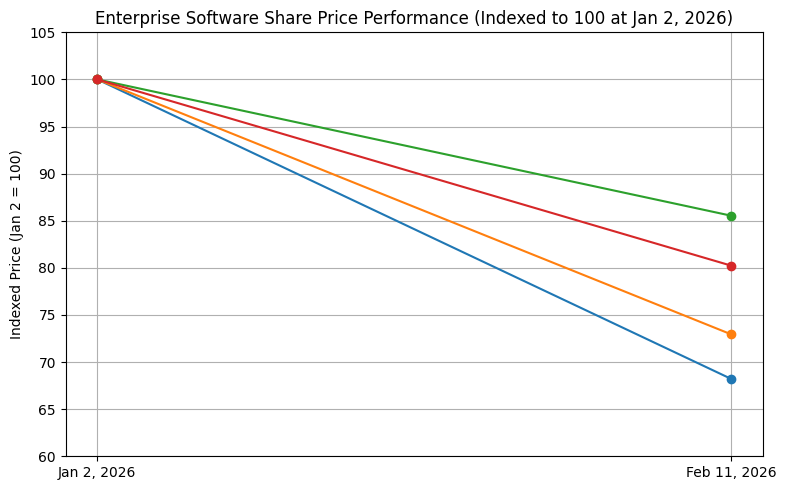
Investors weren’t saying these businesses were broken. They were saying something more subtle, and more important: that the future cash flows of these businesses are now less certain in an AI-accelerated world, effectively introducing an ‘AI-Adjusted Discount Rate’.
That shift has implications well beyond equity markets. It raises a fundamental question for capital planners and investment leaders alike:
Are we still evaluating capital projects as if the future were as predictable as it used to be?
What Actually Changed in The Enterprise Software Market?
The recent sell-off in enterprise and SaaS stocks wasn’t driven by weaker earnings forecasts. In many cases, revenue growth and profitability expectations remained intact.
What changed was the discount rate applied to those earnings. Effectively, the market introduced what we might call an AI-adjusted discount rate to reflect rising uncertainty.
As Reuters reported, investors reassessed how future cash flows should be valued amid growing concern about how quickly AI could disrupt established enterprise software business models. The result wasn’t a downgrade of near-term performance, but a broad re-pricing of risk, with higher uncertainty pushing up the cost of capital used to value long-dated returns.
In simple terms, the further into the future those benefits sit, and the more exposed they are to AI-enabled disruption, the less they are worth today.
Nothing about the underlying businesses changed overnight. What shifted was investor confidence in how long those future benefits would remain defensible in an AI-accelerated world.
Why This Matters For Capital Project Evaluation
Most capital project business cases still rely on familiar financial metrics: Net Present Value (NPV), Internal Rate of Return (IRR), payback period, all calculated using a standard corporate discount rate.
Those methods assume something quietly but critically important: that once a project is approved, its future revenue streams or cost savings are reasonably stable.
AI challenges that assumption.
Not because every project will fail, but because the variability of outcomes has increased. New competitors can emerge faster. Automation can erode advantages sooner than expected. Entire value chains can be reshaped mid-investment cycle, well before projected benefits are fully realized on AI.
Yet in many organizations, projects are still being evaluated using the same discount rate they applied five or even ten years ago, despite a materially different risk profile.
Introducing AI‑Adjusted Discount Rates for Capital Project Evaluation
The idea emerging from recent market behavior, and increasingly discussed in executive circles, is straightforward: if AI increases uncertainty, that uncertainty should be reflected explicitly in project valuation.
In practical terms, this means introducing AI-adjusted discount rates. This is when a project’s discount rate is increased to reflect uncertainty introduced by AI-driven disruption, whether through automation, competitive acceleration, or technological substitution.
Not every project deserves the same adjustment. Exposure varies.
Capital projects with limited vulnerability to AI-driven disruption may retain the standard corporate discount rate. Those with moderate exposure may warrant a modest premium. Initiatives highly susceptible to digital displacement or rapid innovation cycles may justify a more significant adjustment.
The objective is not pessimism. It is comparability.
Two projects can present identical NPVs under a static discount rate. Yet once their exposure to AI-driven uncertainty is recognized, their relative defensibility, and therefore their priority within the project portfolio, may look very different.
AI‑Adjusted Discount Rates Also Apply to Digital Projects
It’s tempting to assume this logic only applies to software or digital initiatives.
It doesn’t.
Physical investments are increasingly exposed as well. Manufacturing assets whose operating models could be automated. Equipment lines vulnerable to rapid technological leapfrogging. Products whose competitive life may shorten as AI accelerates design, optimization, or materials innovation.
A forklift, a production line, or a distribution asset may all carry very different future risk profiles once AI-driven alternatives emerge faster than anticipated. What once looked like a predictable ten-year advantage may compress into something far shorter.
Ignoring that possibility doesn’t remove the risk. It simply buries it inside the valuation.
A Practical Way to Apply AI‑Adjusted Discount Rates
This doesn’t require complex financial modelling or speculative forecasting.
A pragmatic approach can be surprisingly simple. Introduce an AI exposure score into your business case evaluation, translate that score into a risk-adjusted discount premium, and apply it consistently across the portfolio.
The goal is not precision to the decimal point. It is disciplined differentiation.
Not all future cash flows deserve the same level of confidence. Some initiatives are structurally more exposed to rapid technological change than others. Recognizing that explicitly allows capital allocation decisions to reflect reality, rather than assumption.
Importantly, this approach complements existing evaluation dimensions such as strategic alignment, implementation risk, and urgency. It simply strengthens the financial lens through which those dimensions are compared.
From Static Forecasts to Adaptive Project Portfolios
The deeper shift here isn’t about AI itself. It’s about recognizing that capital planning is no longer a static approval exercise. It is becoming a continuous learning loop.
Markets have already made this adjustment. They have begun pricing uncertainty more aggressively, reassessing how durable future cash flows really are in an AI-technology acceleration.
CapEx planners now face the same challenge: How do we prioritize projects when the future is changing faster than our spreadsheets?
Acknowledging AI-impact uncertainty, and embedding it through AI-adjusted discount rates, is one step toward building more resilient portfolios.
Adjusting your project evaluation discount rate for AI-disruption uncertainty doesn’t eliminate risk; it simply stops pretending the future is as predictable as it once was.