

In this article
In this article
AI is no longer an experimental drug. We’re well hooked. AI is now infused in how work is planned, performed, and governed. From field service to the back-office, from predictive forecasting to autonomous operations, AI is becoming embedded across both digital and physical domains.
Traditionally, such broad-based transformation would be implemented under the auspices of a major capital investment. But unlike traditional capital projects, most AI adoption does not begin through formal CapEx processes.
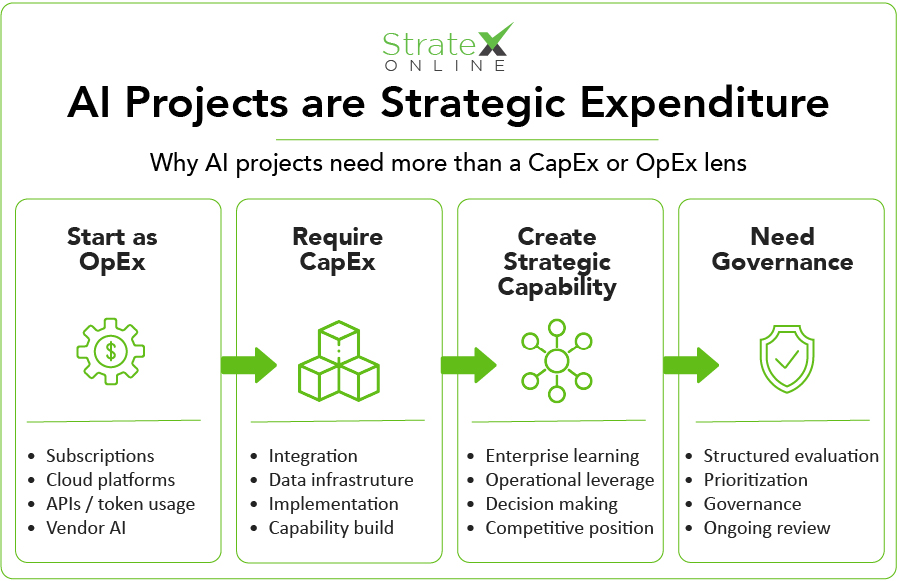
AI often enters the organization through operational expenditure: subscriptions, cloud platforms, APIs, token usage, embedded vendor AI, and departmental experimentation. These investments can start small, funded by operating budgets, and appear manageable at the point of approval.
Soon these pilot AI initiatives also require capital investment in system integration, data infrastructure, implementation programs, platforms, and internal capability development.
Invariably these AI initiatives grow to consume significant OpEx and CapEx, and reshape long-term operational capability, competitive positioning, and enterprise decision-making.
Strategic Expenditure (or StratEx) recognizes that modern strategic investment increasingly spans both CapEx and OpEx. AI projects are one of the clearest examples of this shift.
The Problem with Treating AI Projects as Operational Expenditure
The challenge with AI investment is not that it is classified as OpEx. It is that operational expenditure often sits outside traditional capital visibility and is treated as routine, even when the decision could become strategically significant.
AI purchasing is frequently decentralized across departments, approved through operational budgets, fragmented across vendors and platforms, and embedded within existing software, cloud, or service spend. Each decision may look contained and manageable. But across the enterprise, those decisions can quickly become financially material and strategically impactful before they are formally treated as strategic investment decisions.
That is the key risk.
AI projects can move quickly from small, isolated use cases to business dependency. Once adopted, they can influence how work is performed, how decisions are made, how data is used, and whether capability is built internally, bought from vendors, or locked into external platforms.
By the time the investment appears significant enough for formal capital planning or portfolio governance, the organization may already have committed to tools, workflows, vendors, operating assumptions, and capability paths that are difficult to unwind.
This is why the investment lens matters.
If AI is treated only as operational expenditure, finance may assess the immediate cost without fully assessing the long-term impact. The decision may pass through procurement, but never be tested against enterprise priorities, portfolio duplication, risk assessment, or long-term capability value.
The mistake is not funding AI through OpEx. The mistake is allowing strategically significant AI spend to enter the organization as a routine procurement decision.
The potentially catastrophic impact is not that AI investments are funded departmentally, but rather that they are under-funded and under-resourced.
Too many light-weight, under-funded, under-resourced, poorly focused AI initiatives introduce unexpected security and operational risks, reputational damage, pilot failures and internal resistance.
Why Traditional Capital Planning Struggles with AI Projects
Traditional capital planning was built for investment decisions that can be defined, costed, evaluated, and approved with reasonable confidence.
That works when the project has a stable scope, a predictable cost profile, a clear implementation pathway, and benefits that can be reliably forecast upfront. A plant upgrade, asset replacement, or production line expansion may still carry risk, but the investment is usually bounded enough to support conventional evaluation based on empirical evidence. AI projects rarely stay within those boundaries.
AI by its very nature and design is not deterministic. It is probabilistic. It is not intended to produce consistent algorithmically programmed outputs. It is intended to learn and refine its judgement based on large volumes of data.
Scope can evolve as the technology matures, use cases expand, and new capabilities become available. Costs can shift as usage grows, integrations deepen, data requirements increase, and ongoing support becomes clearer. Benefits may not accrue to a single function or business case, but emerge through productivity, decision quality, customer experience, operational resilience, or enterprise learning.
That is where traditional capital planning can distort the AI investment decision.
Annual planning cycles are often too slow for technologies that change quarter by quarter. Fixed business cases can make AI projects appear more certain than they really are. Static prioritization can lock funding decisions in place before the organization has learned enough. Isolated project evaluation can undervalue shared platforms, reusable capabilities, and cross-functional impact. Deterministic ROI assumptions can penalize investments where value compounds over time.
The result is not simply that AI investments are harder to evaluate. It is that traditional capital models can push them into the wrong decision framework.
They may be delayed because the value is not yet fully visible. They may be approved too narrowly because only the first use case is assessed. Or they may be rejected because they do not fit a model designed for more stable, contained investments.
Traditional capital planning solved for a slower, more certain, more isolated world. AI projects require a model that can account for uncertainty, capability-building, and value that evolves over time.
AI Projects are Strategic Expenditure
AI projects create enterprise capabilities that can compound across functions, platforms, and workflows. Their value often extends beyond direct financial return into operational leverage, faster decision-making, enterprise learning, and future optionality.
That is why accounting treatment should not determine the evaluation process.
A project does not become strategically significant only because it is classified as CapEx. Nor does it become routine simply because it is funded through OpEx. The more important question is whether the initiative will consume material financial or human resources to deliver significant business outcomes.

For AI projects, this matters because the investment often spans both categories. The subscription, model usage, cloud consumption, and vendor capability will be OpEx. The integration, data infrastructure, implementation, and platform development will be CapEx. But the business decision is one decision: whether the organization should commit capital and human resources to building, buying, scaling, or depending on an AI-enabled capability.
When those decisions are separated by accounting classification, governance becomes fragmented. The OpEx component may be approved operationally. The CapEx component may be assessed through project controls. The strategic impact may be dispersed across multiple functions, budgets, and planning cycles.
That separation may satisfy accounting treatment, but it does not provide investment governance.
AI projects require enterprise-level prioritization because they can shape capability, dependency, risk, and competitive position. They need to be evaluated against strategic alignment, portfolio duplication, implementation readiness, risk of inaction, and long-term value creation, not just immediate cost or budget availability.
This does not mean every AI tool needs the same governance as a major capital project. It means organizations need a clear way to identify when an AI initiative has moved beyond routine spend and into Strategic Expenditure.
The defining question is not simply: Is this initiative CapEx or OpEx?
The question becomes: Is this initiative strategically significant enough to require structured evaluation, prioritization, governance, and ongoing review?
Why Finance Teams Must Evaluate Both Sides of Risk
Most investment frameworks are designed to evaluate the risk of action.
What happens if the project fails? What if implementation takes longer than expected? What if costs increase, users do not adopt the solution, or the expected benefits do not materialize?
Those questions still matter. AI projects carry real implementation risk. Models may underperform. Data may not be ready. Integration may be harder than expected. Change management may be underestimated. Vendor and platform decisions may create dependencies that are difficult to unwind.
But AI also introduces another risk that finance teams cannot afford to underweight: the risk of inaction.
What happens if the organization waits too long? What if competitors use AI to lower their cost base, improve customer experience, accelerate decision-making, or attract better talent? What if internal capability gaps widen while other organizations learn, test, scale, and improve?
In a slower investment environment, waiting could be treated as caution. In an AI-enabled environment, waiting can become a decision in itself.
The risk of inaction shows up through operational lag, capability gaps, customer expectations, and competitive disadvantage. It may not appear immediately in a financial model, but it can shape the organization’s future position just as materially as a failed project.
For Strategic Expenditure, risk evaluation must therefore look at both sides of the decision:
What could go wrong if we proceed? And: What could be lost if we do not?
Finance teams do not need to abandon discipline to move faster. They need a risk model that recognizes that delay, underinvestment, and fragmented experimentation also carry cost.
Why Dispersed AI Projects Limit Enterprise Transformation
AI activity is everywhere. Coordinated AI investment is far less common.
Without a Strategic Expenditure lens, AI projects can multiply across the business without forming a coherent enterprise capability. One team trials a co-pilot. Another builds an automation workflow. Another adds AI capabilities through an existing vendor. Another experiments with predictive analytics. Each initiative may be useful, but the overall pattern can become fragmented.
The result is often a long tail of disconnected AI activity:
- siloed pilots
- duplicated spend
- fragmented learning
- disconnected tooling
- isolated wins
- shadow AI
- non-scalable experimentation
The value stays local rather than compounding across the enterprise.
When teams solve similar problems separately, the organization loses the chance to build common platforms, shared data foundations, reusable patterns, and enterprise learning. Success stays local. Lessons are not transferred. Governance varies by team. Vendor decisions are made in isolation. Capability develops unevenly.
That is how AI investment can grow without transformation scaling.
Strategic Expenditure management gives finance and leadership teams a way to see AI projects as part of a broader portfolio, not as disconnected operational requests. It creates the basis for portfolio visibility, shared capability development, enterprise platform decisions, and more deliberate prioritization.
Strategic Expenditure Requires a Different Operating Model
Managing AI as Strategic Expenditure requires more than tighter approval controls. It requires a different operating model for how AI initiatives are identified, evaluated, prioritized, funded, and reviewed.
The first requirement is knowing what AI investment is already underway. Finance and leadership teams need a clear view of AI activity across the organization, including proposed initiatives, active pilots, embedded vendor capabilities, platform investments, and projects already moving into operational use. Without that visibility, it is difficult to understand where resources are going, where duplication is occurring, and which initiatives are building meaningful enterprise capability.
From there, AI projects need to be assessed at portfolio level, not just as individual requests. The question is not only whether a project has value on its own, but whether it supports the organization’s strategic priorities, strengthens shared capability, competes with similar initiatives, or depends on other investments to succeed.
This also changes the cadence of governance. Annual evaluation is too slow for AI projects that evolve as models, vendors, costs, risks, and use cases change. Strategic Expenditure requires continuous review, dynamic prioritization, and the ability to reallocate funding as evidence improves.
The evaluation model also needs to expand. Financial return still matters, but AI projects should also be assessed for operational impact, strategic alignment, capability value, implementation risk, risk of inaction, and long-term enterprise dependency.
That is the discipline Strategic Expenditure brings to AI investment. Strategic Expenditure (StratEx) Management transitions AI investment evaluation from isolated approval decisions to a structured, portfolio-level discipline, one that connects CapEx and OpEx, supports better trade-offs, and gives finance teams a more defensible way to govern strategically significant AI spend and resource allocation.
AI Projects Require a Different Capital Mindset
Traditional capital structures were built for decisions that could be defined, costed, approved, and controlled with reasonable certainty. AI projects are different. They evolve through use, expand across functions, and create value through learning, reuse and scale.
Approval is only the starting point. The real challenge is keeping AI investment governed as it moves from experiment to scaled capability.
Strategic Expenditure provides the layer between experimentation and transformation. It helps leadership teams identify which AI initiatives deserve serious financial and organizational commitment, which risks need to be managed, and where fragmented activity should be consolidated into enterprise capability.
Done well, Strategic Expenditure governance does two things.
First, it helps organizations commit properly to high-potential initiatives. AI projects cannot scale on enthusiasm alone. They need funding, sponsorship, integration, data, change management, and ongoing support if they are going to move from pilot to production and deliver real value.
Second, it helps organizations respond to competitive threats before the business case is perfectly certain. In some cases, the risk of inaction may be greater than the risk of acting. Waiting for complete certainty can mean allowing capability gaps, customer expectations, and competitor advantage to compound.
The challenge is no longer deciding whether to invest in AI. It is deciding how to govern AI investment before it fragments across the enterprise.