

In this article
In this article
When you’ve spent enough years managing capital projects, you start to notice a pattern: everyone requests CapEx reporting, but very few people truly trust it. The numbers rarely tell the full story in the moment you’re viewing them. You’ve likely sat in meetings where a report looked solid on paper, yet everyone in the room knew the reality had already shifted; a forecast changed, an approval was delayed, or delivery had moved on without the data keeping pace.
It’s not hard to see why this happens. The information you depend on is scattered across too many places. Actuals sit in your ERP system, budgets in planning tools, approvals in inboxes, and forecasts in a variety of spreadsheets. By the time all the data is brought together, you’re already a few steps behind.
This is where integrated CapEx Management Analytics makes a noticeable difference. When all the core data (actuals, budgets, approvals, and forecasts) are collated in one environment, reporting stops feeling like a reconstruction exercise. It becomes a current, reliable view of how capital is actually performing. We’ve seen the shift firsthand: fewer surprises, fewer late-night reconciliations, and far more useful conversations in the room.
It also sharpens Project Forecasting. When delivery teams and finance are feeding updates into the same system, forecasts stabilize, timing pressures become visible earlier, and the whole project portfolio becomes easier to steer with confidence.
This blog looks at how analytics strengthens CapEx reporting, and why a more connected approach creates calmer, clearer, and genuinely more useful decision support for anyone responsible for managing capital.
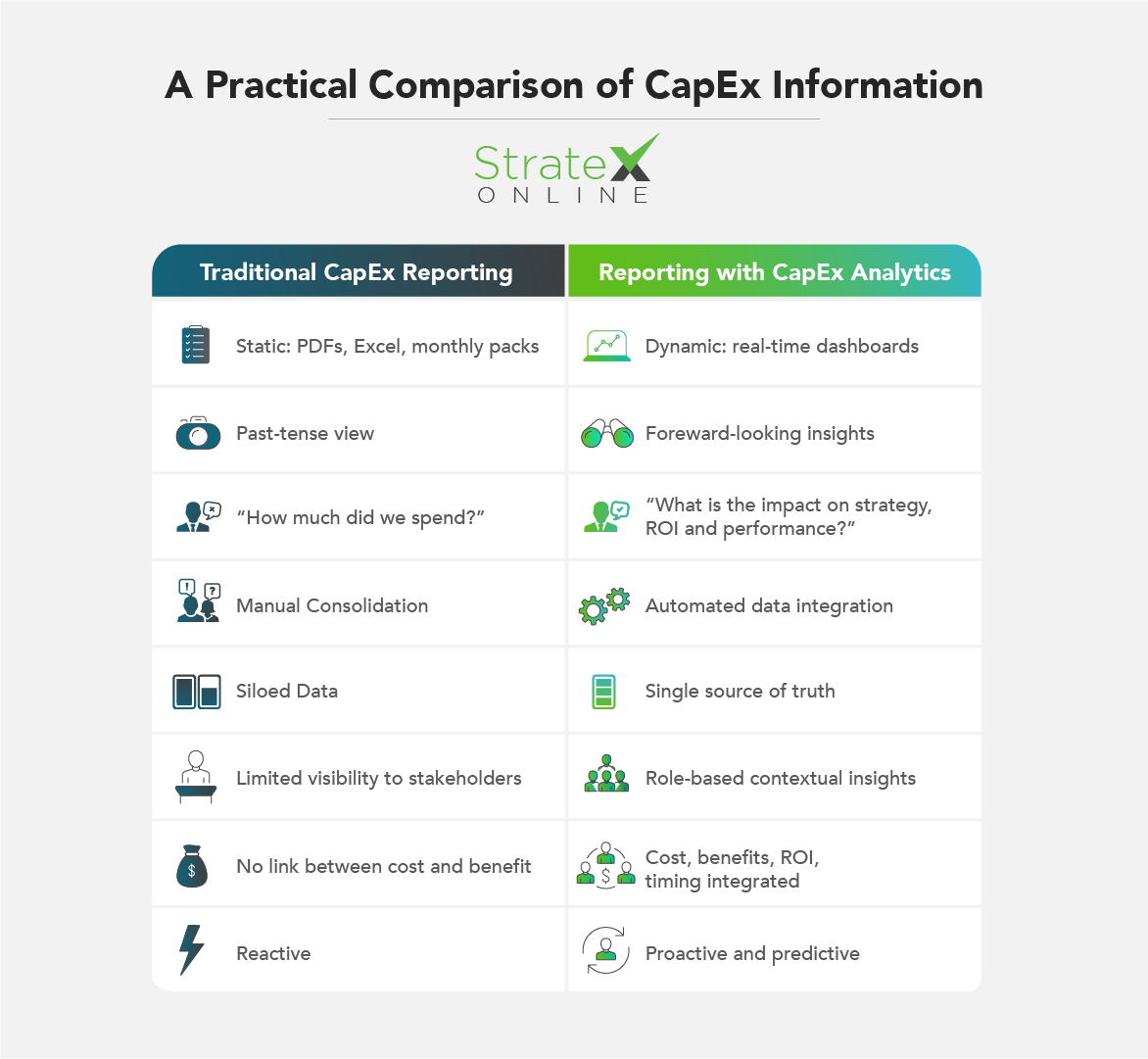
Traditional CapEx Reporting vs Integrated CapEx Analytics
Traditional CapEx reporting tells you what happened, while CapEx analytics helps you understand what it means and what to do next.
The 4 Limitations of Traditional CapEx Reporting
You’ve probably seen CapEx reporting take many forms; thick board packs, color-coded spreadsheets, polished dashboards, and everything in between. The presentation changes, but the underlying challenges rarely do. The further you look behind the scenes, the more you notice the same patterns repeating themselves.
1) Reports age faster than we can use them
You’ve likely experienced the moment a month-end pack has been declared “final,” only to be outdated by the time it reaches the next meeting. Static PDFs and spreadsheets simply can’t keep up with how quickly CapEx forecasts move. They’re hard to interrogate, offer no drill-down, and take enormous manual effort to stitch together. By the time all the data is reconciled, the business has already shifted again.
2) Spreadsheets quietly bend the truth
Spreadsheets are familiar and flexible and often the only tool teams feel they truly control. But they have a habit of wandering. A broken formula, a renamed tab, or a stray copy-paste can change a result without anyone noticing. You’ve probably seen conversations derailed because two versions of “the same file” didn’t match. And without an audit trail, finding the source of the issue becomes a treasure hunt no one has time for.
3) Fragmented data creates a fragmented CapEx story
CapEx information tends to live everywhere: actuals in the ERP, budgets in planning tools, approvals in email threads, forecasts in someone’s personal file. On their own, each source tells a part of the story. But when they’re brought together, the pieces rarely click as neatly as they should.
A simple timing update in engineering can take days to surface. An approval can lag while the project keeps moving. Finance ends up reconciling versions that almost match, but not quite. It’s in these gaps that the narrative starts to fray, and reporting becomes more of an assembly exercise than a true reflection of what’s happening.
4) Reporting tells us what we spent, but not what it means
Traditional CapEx reports do a reasonable job of showing spend-to-date and variance to budget. But they don’t always answer the questions leaders actually ask:
- Why did spend change?
- How are scope or timing changes affecting outcomes?
- Does the project remain viable?
- Is capital allocation still aligned to strategy?
- What is the impact on benefits, ROI, or operational delivery??
Without this context, reporting risks becoming a recap of the past instead of a guide for what’s coming next.
The Data and Context Needed for CapEx Reporting
The quality of CapEx reporting rarely comes down to the report itself, it comes down to the inputs. When the underlying information is incomplete, inconsistent, or too high-level, the reporting layer can only do so much. Strong CapEx reporting depends on complete and connected context, and the same core data needs appear in every organization.
The baseline: how much we’re spending
Every report starts here, and it needs to. But anyone who’s managed a capital project portfolio knows this number becomes meaningful only when you understand the layers behind it: what changed, what’s ahead, and whether the plan still holds.
What are we spending it on?
One of the quickest ways to understand an organization’s priorities is to look at how capital splits between growth, replacement, compliance, and operational resilience. Leadership teams can shift entire conversations once they realize their spend mix doesn’t match the strategy they thought they were executing.
4 Comparisons That Enhance Capital Reporting
On their own, actuals don’t tell you enough. The power comes from the comparisons between actuals and reference amounts, as unexpected variances help focus attention for each level of management:
1) Actuals vs original plans
This shows how project intent has shifted. Plans are built with the best information available at the time, so when actuals diverge, it often signals changes in scope, risk, or timing that need attention.
2) Actuals vs budgets
Budget comparisons only make sense when you understand how those budgets were set. Some organizations use Zero-Based Budgeting, building everything from the ground up. Others work to top-down targets set by executives. Many follow a hybrid model: major projects are budgeted early, and the remaining capital sits in pools that engineering or operations allocate through the year.
When you compare actuals against these structures, don’t just check spend. Check whether capital is flowing the way the organization intended and whether the budgeting approach still reflects what’s happening on the ground.
3) Actuals vs approved amounts
This one is essential. Budgets show what was set aside; approvals show what the organization has formally committed to spend. The two rarely align perfectly; major projects, direct works, and emergency or unbudgeted initiatives often follow different approval paths.
Approved amounts also shift as projects encounter technical issues or cost variations, and reporting needs to reflect these updates quickly. Comparing actuals to approved expenditure shows who authorized the spend, when it was committed, and whether delivery is staying aligned with those approvals.
4) Actuals vs targets
Targets anchor expectations at an organizational or business unit level. They do not cascade down to individual projects, but they do reflect how much investment stakeholders expect based on the organization’s industry, growth phase, and competitive pressure.
For example, in the current environment, hyperscalers building out AI infrastructure will be targeting heavy CapEx investment, possibly even a multiple of their revenue, whilst a mature manufacturer may simply target steady reinvestment in line with their current depreciation expense.
Comparing actuals to these targets shows whether spending levels match organizational goals and industry norms. It’s a quick way to interpret whether capital investment is strategically appropriate for where the business is and where it intends to go.
Actuals at the WBS or component level
Viewing actuals at the WBS or component level helps engineering and project teams identify cost drivers early and manage overruns. When project structures and budgets are properly set up in the ERP, you get real-time operational analytics instead of delayed snapshots. At this level, committed, incurred, and forecast spend can be seen together, making it easier to understand where the project is heading and where action is needed.
Forecasting is the heartbeat of CapEx reporting
Forecasts tell you more about how the year will end than any budget ever will. They capture timing shifts, delivery realities, and updated expectations long before they appear in actuals.
But capital project expenditure forecasts only work when they’re updated consistently and flow into reporting in real time. When they sit in individual spreadsheets, the signal gets lost. When they’re connected to the reporting environment, they become one of the most powerful tools for steering capital performance.
How Integrated Capital Reporting and Analytics Improves Reporting Effectiveness
When CapEx reporting stops being a manual chase and starts becoming something leaders can genuinely rely on, here’s what changes.
1) Real-time visibility instead of monthly catch-up
Dashboards that update continuously with live actuals, forecasts, and variances, shifts the whole reporting cycle. You’re no longer waiting for month-end to understand what changed. Issues surface earlier, questions are easier to answer, and more timely decisions.
2) Integrated data means a single source of truth
When actuals, budgets, approvals, and forecasts are unified in one environment, reporting becomes far more consistent. The reconciliation burden drops away, inconsistencies shrink, and everyone is finally working from the same picture.
3) Performance becomes easier to interpret
CapEx Reporting becomes far more useful when the context is built in. Variances link automatically to plans, budgets, and approvals, so you can see what changed and why without chasing explanations. Forecast revisions are tracked over time and by cost driver, making trends and deviations much clearer.
WBS visibility becomes practical too. You can drill into the components driving movement instead of searching through spreadsheets. And with approval logic surfaced in the same view, it’s immediately clear what spend was authorized and what wasn’t.
4) Reporting starts looking forward, not back
Predictive forecasting and scenario views make future impacts clearer. A shift in timing or cost doesn’t become a surprise later, you see its trajectory now, and the portfolio becomes much easier to steer with confidence.
5) Portfolio decisions become more deliberate
Once reporting moves from isolated project snapshots to a connected portfolio view, prioritization sharpens. You can see which initiatives need support, where risks are emerging, and how capital can be better deployed across the year.
CapEx and OpEx: Why Both are Utilized in CapEx Reporting
While CapEx and OpEx are separated cleanly for accounting purposes, they’re tightly connected in the way organizations actually deliver projects. Reporting that excludes OpEx misses a key part of the investment picture.
1) Both expenditures influence long-term performance
CapEx and OpEx may sit in different buckets, but they drive value together. Many OpEx-heavy initiatives (especially in technology, services, and modernization) behave like capital investments even if they don’t meet the accounting definition. If you leave them out of the reporting view, you miss part of the investment story.
2) OpEx can carry strategic weight
Some operating expenditure fundamentally shifts capability: cloud migrations, SaaS platforms, digital infrastructure, safety or sustainability programs. These initiatives influence competitiveness and efficiency just as strongly as physical assets, and your reporting should reflect their impact.
3) Integrated analytics helps you see the total cost of ownership
This is where analytics pulls everything together. Instead of juggling CapEx in one system and OpEx somewhere else, you get a unified view of the full investment lifecycle: capital outlay, operating cost, timing, and future commitments.
Spreadsheets struggle with this. Integrated reporting handles it naturally.
When CapEx and OpEx sit in the same analytical view, it becomes much easier to understand:
- the real cost of delivering an initiative
- how OpEx shifts as assets come online
- whether long-term value still holds once lifecycle costs are considered
And that’s when reporting starts supporting better decisions, not just better reconciliations.
The Stakeholder Benefits of Analytics-Driven CapEx Reporting
When CapEx reporting becomes clearer and more connected, every part of the organization feels the shift. The benefits show up differently for each stakeholder group, but they all lead to the same outcome: better visibility, better alignment, and better decisions.
Executives — a clearer view of the portfolio
With analytics behind your reporting, you can quickly see whether capital is flowing to the right priorities and whether the portfolio reflects the organization’s strategic intent. Growth vs replacement ratios become clearer, trends are easier to spot, and the overall investment posture is far less ambiguous.
Finance — confidence in forecasts and fewer surprises
Integrated reporting takes a lot of friction out of month-end. Forecasts stabilize because updates flow automatically, variances come with context, and you can model year-end P&L, Balance Sheet and Cashflow outcomes with far more certainty. The time saved on reconciliation is often matched by the reduction in unexpected movements.
Engineering and Delivery — visibility into costs and approvals
When reporting is connected to WBS-level detail, it becomes easier to manage commitments, understand cost drivers, and address issues before they escalate. Clear approval visibility also helps delivery teams understand what’s been authorized, and what hasn’t, so financial and operational expectations stay aligned.
Shareholders and External Stakeholders — a better story of investment
Stronger CapEx reporting paints a clearer picture of how the organization is investing: where it’s growing, where it’s renewing, and where capital might be under- or over-extended. It becomes easier to demonstrate discipline, alignment, and the link between investment and long-term value creation.
The Future of CapEx Reporting: Integrated, Connected, Analytics-Driven
Looking ahead, the biggest shift in CapEx reporting isn’t about new dashboards or clever visualizations, it’s the move away from treating reporting as a standalone task. The more the capital cycle is connected, the less time you spend rebuilding the story each month and the more time you spend steering it.
Integrated analytics is what makes that possible. When budgets, approvals, actuals, forecasts, and project analysis all live in the same place, reporting stops feeling like assembly work. Everything moves together. Updates flow naturally. And the gaps you used to chase start to disappear.
Enterprise reporting tools still have a role, they’re great at presenting and distributing information but they can only show what’s already connected underneath. They surface the picture; they don’t create it.
That foundation comes from having one environment that carries the full capital conversation: the plans you commit to, the approvals you grant, the costs you incur, and the forecasts you adjust. When this sits together, as it does in Stratex Online, CapEx reporting becomes clearer, faster, and more reliable.
And once you work that way, it’s hard to imagine going back. The organizations moving quickest are the ones treating CapEx reporting as part of how they run the portfolio every day as a continuous view that supports wise and more confident CapEx investment decisions.