In this article
- Where AI Capital Investment Decisions Actually Break
- Why Capital Investment Ranking Becomes Misleading for AI projects
- Using Platform Thinking as Strategic Direction-Setting for Capital Investment
- The Hidden Insight in the Project Intake List
- Real Capital Investment Risk: AI Dilution
- What Changes When Capital Committees Accept Uncertainty
- AI Capital Investment Is a Long-Term Capability Commitment
- FAQs on AI Capital Investment
In this article
- Where AI Capital Investment Decisions Actually Break
- Why Capital Investment Ranking Becomes Misleading for AI projects
- Using Platform Thinking as Strategic Direction-Setting for Capital Investment
- The Hidden Insight in the Project Intake List
- Real Capital Investment Risk: AI Dilution
- What Changes When Capital Committees Accept Uncertainty
- AI Capital Investment Is a Long-Term Capability Commitment
- FAQs on AI Capital Investment
AI capital investment proposals are now arriving at capital committees faster than the decision frameworks designed to evaluate them can adapt. The result is structural tension: AI capital investment decisions require a fundamentally different evaluation logic from traditional capital projects.
Unlike traditional capital investments, AI initiatives rarely come with reliable forecasts. Costs are uncertain. Benefits are diffuse. Timelines shift. Reliability, change impact, and competitive threat often matter more than short-term return, yet capital processes still demand effective justification at approval time.
This creates a dangerous illusion of discipline. Capital projects that look predictable rise to the top, while investments that could reshape the organization appear weak, risky, or premature. In an environment defined by rapid technological change, waiting for certainty becomes a strategic decision in itself.
This article takes a clear position: AI capital investment decisions cannot be treated as a series of standalone projects. They must be evaluated as a coordinated platform investment. Not because AI is special, but because the assumptions behind traditional capital decision-making do not translate cleanly to AI-enabled initiatives.
Where AI Capital Investment Decisions Actually Break
AI capital investment decisions break during evaluation because traditional CapEx structures demand certainty that AI initiatives cannot provide. Therefore, AI in CapEx management must focus on aligning AI initiative confidence with CapEx structure.
AI proposals reach capital committees while key variables are still forming:
- Cost ranges remain fluid
- Value is directional rather than proven
- Reliability and organizational impact are still emerging
These are not planning failures. They are inherent characteristics of AI-enabled investments. In our work with capital-intensive organizations, we see this pattern repeatedly.
Traditional Capital Expenditure (CapEx) frameworks were built for a different investment profile. They assess bounded assets, stable operating models, and benefits that can be justified at approval time. For conventional capital projects, this structure works because scope is finite and outcomes are relatively predictable.
AI capital investments behave differently:
- Value develops through learning and reuse
- Use cases expand over time
- Capability compounds rather than completes
There is no clear transition from approval to “done.”
The structural tension is unavoidable. CapEx processes expect confidence at approval. AI initiatives require confidence to be built through iteration. When these logics collide:
- Assumptions harden prematurely
- Benefits are narrowed to fit templates
- Uncertainty is suppressed rather than examined
The ideas are not weak. The evaluation structure is misaligned.
Why Capital Investment Ranking Becomes Misleading for AI projects
Familiar capital metrics do not simply fall short when applied to AI capital investment decisions. They distort prioritization.
Most capital investment ranking systems place significant weight on measures such as:
- Payback period
- Internal rate of return (IRR)
- Net present value (NPV)
- Early-year benefit realization
These metrics are designed to compare investments with definable scope and observable returns. When they dominate ranking decisions, certain patterns follow:
- Predictability is rewarded over adaptability
- Localized returns outrank shared or enabling value
- Short-term certainty is interpreted as lower risk
AI-enabled investments enter this ranking environment at a structural disadvantage.
Their value is rarely concentrated in a single, measurable outcome. Benefits accrue unevenly across functions and over time. Learning effects model refinement, reuse, and expanded application cannot be priced precisely at approval.
When AI capital investments are ranked alongside contained initiatives, the result is systematic skew:
- Incremental, well-contained projects rise in priority
- Strategically urgent, enabling AI investments fall
This is not a failure of judgement. It is a predictable outcome of applying established financial metrics to a different class of investment.
The effect is subtle but consequential. Capital allocation becomes increasingly conservative at the very moment adaptability, leverage, and optionality matter most.
Using Platform Thinking as Strategic Direction-Setting for Capital Investment
Platform thinking shifts how AI capital investment is evaluated, from project selection to strategic direction-setting.
The core question changes. Instead of asking which individual AI projects should be approved, capital committees ask what AI-enabled capabilities the organization is deliberately building over time.
This distinction matters because AI investments do more than deliver discrete outcomes. They shape how decisions are made, how data flows across functions, how work is coordinated, and which strategic options remain available in the future.
Under platform thinking, capital investment decisions are not treated as isolated approvals. Each allocation is evaluated for how it reinforces (or fragments) long-term capability. The emphasis moves from validating individual proposals to understanding how capital accumulates.
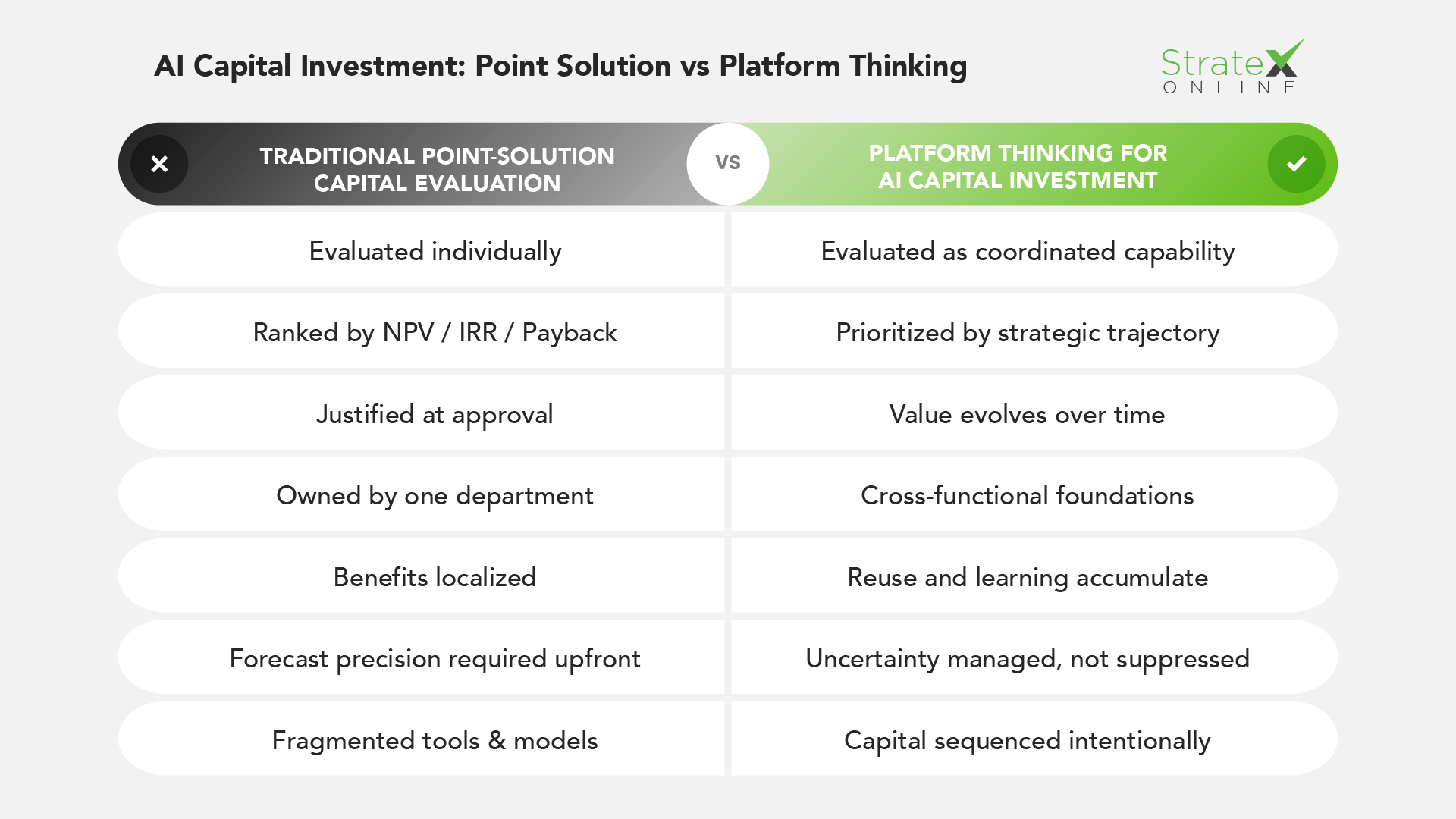
AI capital investment decisions evaluated as platform commitments build shared capability. Evaluated as point solutions, they fragment.
Capital evaluation becomes an exercise in trajectory. It determines:
- Which capabilities to strengthen
- Which paths to commit to
- Which experiments to stage
- Which directions to avoid
Trade-offs are approached differently. Capital is not allocated solely to what can be justified with the highest precision today, but to what best advances the organization’s intended AI trajectory.
Financial discipline remains essential. Metrics still inform decisions. But they no longer override strategic direction when uncertainty is inherent.
The purpose of platform thinking is not efficiency or speed. It is coherence. Capital investment choices must accumulate toward a deliberate AI capability rather than disperse across disconnected initiatives.
The Hidden Insight in the Project Intake List
The most important AI capital investment is often not proposed explicitly.
When AI investment proposals are evaluated individually, each appears as a contained request with a local rationale. A forecasting enhancement for one business unit. A predictive model for a specific asset class. A workflow optimization within a single function.
Viewed one at a time, these initiatives seem unrelated.
Viewed together, they reveal patterns.
Across the intake list, recurring signals often emerge:
- Overlapping ambition across functions
- Repeated demand for similar data foundations or decision capability
- Parallel attempts to solve adjacent aspects of the same underlying problem
At project level, these appear incremental. At portfolio level, they suggest something different.
The real opportunity is frequently not departmental but cross-functional. Not additive but consolidative. Not a series of small upgrades, but a shared capability that would eliminate duplication and increase leverage across the organization.
In many cases, the most valuable AI capital investment is not fully articulated in any one request. It is implied by the collection of submissions taken together.
Platform thinking makes that implicit signal visible.
Real Capital Investment Risk: AI Dilution
The most common AI failure mode is not underinvestment. It is fragmented capital allocation.
Once AI opportunities are absorbed into departmental budgets, capital decisions tend to optimize locally rather than collectively. Each function justifies its own initiative. Each team pursues its own model, vendor, or data layer. Coordination becomes secondary to approval.
The outcomes are predictable:
- Capability is duplicated and funded multiple times
- Learning remains confined within individual teams or tools
- Overlapping platforms, models, and skills evolve in parallel
At portfolio level, this can look like progress. Multiple AI initiatives are approved. Spend accumulates. Milestones are reported.
But capability does not compound.
Reuse is limited. Data remains siloed. Strategic leverage fails to materialize. The organization appears active, yet advantage remains marginal.
The risk is subtle but material. Capital is not withheld from AI, it is dispersed too thinly to generate meaningful scale.
Over time, this creates a widening gap between perceived AI maturity and actual competitive position.
AI investments begin to deliver outsized returns only when capital is deliberately coordinated, prioritized around shared capability, and concentrated on what matters strategically, not just locally.
What Changes When Capital Committees Accept Uncertainty
When capital committees accept that uncertainty is inherent in AI capital investments, evaluation shifts from forecast precision to strategic judgement.
The focus moves away from eliminating uncertainty at approval time and toward distinguishing between uncertainty that will resolve through learning and uncertainty that creates strategic exposure if ignored.
Different questions begin to dominate discussion:
- How strategically important is this capability if it works?
- What is the risk of not investing now?
- Is the organization ready to absorb and scale this capability?
- How will reliability, governance, and control evolve as use expands?
In many cases, the greater risk is not making the wrong investment. It is making no enabling investment at all.
Financial metrics remain part of the discussion. But their role changes. Measures such as NPV or IRR inform trade-offs; they no longer determine outcomes. Forecast precision is treated as directional rather than definitive.
This alters how proposals are debated. Less time is spent defending forecast accuracy. More time is spent examining assumptions, dependencies, sequencing, and long-term implications.
Capital committees stop asking for certainty that cannot exist. Instead, they assess whether uncertainty is acceptable, manageable, and aligned with strategic intent.
The result is not indiscriminate risk-taking. It is deliberate risk allocation capital deployed intentionally to build long-term capability and competitive position.
AI Capital Investment Is a Long-Term Capability Commitment
AI-enabled capability is not delivered through a single project or approval cycle. It is built through a sequence of capital decisions that accumulate over time.
This shifts the capital challenge from selecting the “right” AI projects to sequencing capability investments early enough to matter.
Each allocation contributes to a broader trajectory. Investments adapt as use cases evolve. Value extends beyond the original scope. Capability strengthens through reinforcement and reuse.
Unlike traditional capital assets, AI capability is never complete. Its relevance depends on learning, adoption, and reinvention, not on commissioning or depreciation schedules.
This reframes the central capital question. It is no longer limited to the projected return of a discrete project. It becomes a strategic consideration: whether this capability is essential to how the organization will operate and compete in the future.
Organizations that recognize AI investment as a capability commitment allocate capital with intent. They concentrate resources around shared foundations, sequence investments deliberately, and build advantage cumulatively rather than independently.
AI capital investment decisions, when treated as platform commitments rather than isolated approvals, shape not just project outcomes but organizational direction and provide strategic optionality.