

In this article
- What is FEL2 and Why Does it Matter?
- FEL2 as Engineering’s Project Portfolio-Gate
- FEL2 Deliverables: What Engineering Produces at Front End Loading Stage 2
- How FEL2 Enables a Rolling Pipeline of Engineering Projects
- How FEL2 Strengthens Total Cost Management Outcomes
- The Two Core Engineering Project Portfolio Challenges in FEL2
- Challenge 1: Internal Prioritization
- Challenge 2: External Justification
- How Stratex Online Strengthens Engineering Portfolios in Front End Loading
- The Organizational Impact of Strong FEL2 Governance
- FEL2 Is Engineering’s Moment of Influence
- FAQs on Front End Loading Stage 2
In this article
- What is FEL2 and Why Does it Matter?
- FEL2 as Engineering’s Project Portfolio-Gate
- FEL2 Deliverables: What Engineering Produces at Front End Loading Stage 2
- How FEL2 Enables a Rolling Pipeline of Engineering Projects
- How FEL2 Strengthens Total Cost Management Outcomes
- The Two Core Engineering Project Portfolio Challenges in FEL2
- Challenge 1: Internal Prioritization
- Challenge 2: External Justification
- How Stratex Online Strengthens Engineering Portfolios in Front End Loading
- The Organizational Impact of Strong FEL2 Governance
- FEL2 Is Engineering’s Moment of Influence
- FAQs on Front End Loading Stage 2
Front End Loading stage 2 (FEL2) is the most consequential point of influence for engineering planning. It’s where engineering teams must turn emerging technical problems, risks, and opportunities into a project portfolio that is credible, justified, and ready to compete for funding.
What is FEL2 and Why Does it Matter?
FEL2 shapes the quality and competitiveness of the entire engineering project portfolio. At this point in the FEL stage sequence, early technical definition becomes structured enough for portfolio decisions, long-term cost shaping, option evaluation, and alignment with operational and strategic priorities.
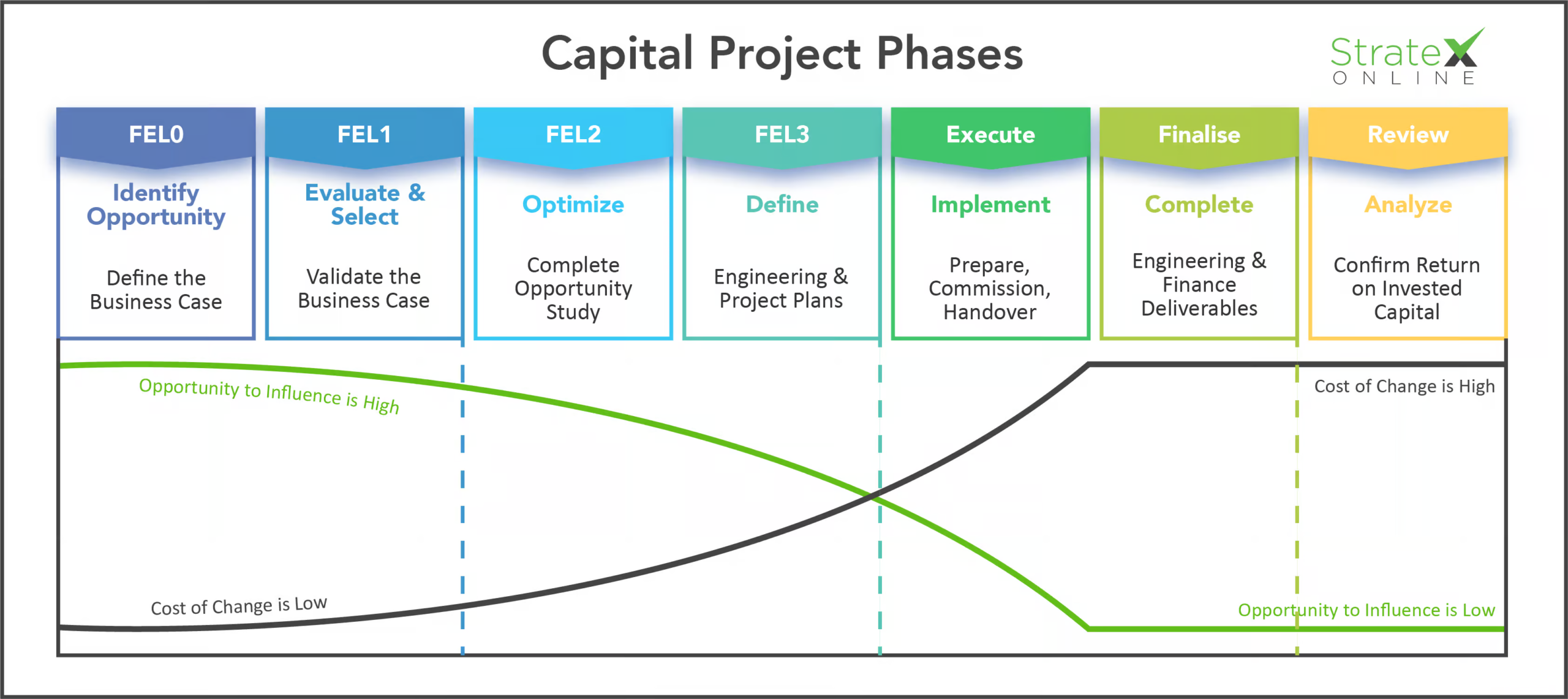
When FEL2 is strong, engineering maintains a rolling, optimized pipeline of projects that can advance or defer as conditions change. This pipeline is crucial to supporting both Total Cost Management principles and finance’s need for clarity, consistency, and risk visibility. When FEL-2 is weak, technically urgent projects struggle to compete, portfolios become unbalanced, downstream costs escalate, and engineering loses influence in capital planning.
This article explores how engineering can use FEL2 as its portfolio governance gate; why FEL2 maturity underpins lifecycle cost, option quality, and portfolio balance; and how to overcome the internal (prioritization) and external (justification) challenges that often derail submissions. It also shows how Stratex Online strengthens FEL2 by standardizing scoring, comparability, and business-case logic; so engineering projects enter capital planning with clarity, evidence, and competitive standing.
FEL2 as Engineering’s Project Portfolio-Gate
By the time a project reaches FEL2, engineering already understands the problem. Asset condition, operational risk, and technical constraints are rarely a mystery. What remains uncertain is the best response; the scale, timing, and configuration that resolve the issue without creating unnecessary cost or disruption.
At FEL2, engineering stops expanding the problem space and starts narrowing it. Options are defined, assumptions are tested, and trade-offs become explicit. The focus shifts from “can this be done?” to “which approach makes the most sense given risk, cost, and long-term performance?”
This is what makes FEL2 the decision gate for the engineering project portfolio.
How Portfolio Decisions Take Shape in FEL2
Capital portfolios are built from choices, not problem statements. During FEL-2, engineering applies judgment to determine:
- Which initiatives are sufficiently defined to proceed toward detailed design,
- Which issues are technically real but not yet mature enough to justify capital,
- Which efforts represent major, multi-year investments versus targeted interventions,
- Which solution paths meet requirements with the least lifecycle cost, complexity, or operational impact.
These are engineering decisions rooted in experience with constructability, operability, maintainability, and risk; not abstract financial filtering. With discipline at FEL-2, engineering actively shapes what advances and what waits, instead of allowing urgency alone to dictate the portfolio.
FEL2 Deliverables: What Engineering Produces at Front End Loading Stage 2
The outputs produced during FEL-2 are familiar to engineering teams, but their role changes at this stage. Early definition becomes structured enough to support comparison and prioritization across the portfolio.
Typical FEL-2 activities include:
- Scope definition with clear boundaries, assumptions, and constraints,
- Feasibility-level cost estimates (AACE Class 4) that acknowledge uncertainty,
- Evaluation of major equipment and system alternatives,
- Preliminary alignment with shutdown and outage windows,
- Initial HAZOPs and structured risk identification,
- Condition-based evidence from inspections, reliability analysis, and OT data,
- Early procurement insight into lead times, vendor availability, and supply risk.
Individually, these are standard engineering activities. Together, they form the foundation for informed engineering project portfolio decisions.
Structuring Investment Initiatives for Engineering Project Portfolio Readiness
The shift during FEL-2 isn’t technical rigor, engineering brings that from the start. What changes is the decision context.
Projects now need to stand alongside other engineering initiatives and be evaluated as part of a broader portfolio. To do that effectively, each project must be represented in a consistent, structured form that clearly demonstrates:
- Strategic alignment
- Risk of non-execution
- Urgency and timing sensitivity
- Cost range and confidence level
- Operational, financial, and compliance benefits
This structure doesn’t constrain engineering judgment; it makes it comparable. With this level of maturity, projects can move forward, or be held, without losing context. That discipline enables engineering to maintain a flexible, rolling pipeline of work as conditions change.
How FEL2 Enables a Rolling Pipeline of Engineering Projects
The rolling pipeline begins during FEL0 and FEL1, but it is FEL2 that gives engineering projects the definition, standardized evaluation, and justification required to become decision-ready and comparable within the capital portfolio.
With scope, cost ranges, risks, and options defined to a common standard, engineering can manage its portfolio dynamically rather than treating the capital plan as a fixed list.
Why a Rolling Project Pipeline Matters in FEL2
When asset condition worsens, production priorities shift, or shutdown windows move, engineering can advance or defer projects with confidence because each candidate has already been developed to a comparable level of maturity.
This capability supports:
- Substitution becomes possible because projects share a consistent level of maturity.
- The engineering portfolio stays balanced across reliability, compliance, replacement, and growth.
- Decision-makers gain visibility into urgency, consequence-of-deferral, cost ranges, and option pathways early before FEL3 locks in commitments.
Rather than reacting to disruption, engineering stays prepared.
How FEL2 Supports Capital Planning
The rolling pipeline lives within engineering, while capital approval sits with finance. FEL2 provides the structure that allows both groups to operate effectively within their roles.
Because FEL2 outputs are consistent, each project presents a clear picture of maturity through:
- Defined cost and schedule ranges
- Transparent consequence-of-deferral logic
- Clear risk and readiness indicators
- Structured comparisons between alternative solutions
This allows finance to adjust the capital plan when conditions change without losing control of budget exposure, risk posture, or strategic alignment.
Engineering benefits as well. Projects do not need to be rebuilt mid-cycle to regain attention. The technical work already done in FEL2 remains valid and usable.
A rolling pipeline is not a separate governance process. It is the natural outcome of disciplined FEL0 through FEL2 work. When projects reach FEL2 with consistent definition and justification, engineering maintains a slate of credible options that can move forward as needed. Decisions become controlled adjustments rather than disruptive resets.
That same discipline also shapes long-term cost and risk outcomes across the project lifecycle. The way options are defined and compared in FEL2 has a direct impact on total cost and execution performance.
How FEL2 Strengthens Total Cost Management Outcomes
Beyond portfolio sequencing, FEL2 plays a central role in shaping total cost management (TCM) outcomes across the project lifecycle. This stage is where early technical definition becomes structured enough to influence long-term cost, risk, and execution performance in a meaningful way.
Engineering takes emerging scope, constraints, and condition data and translates them into defined options. The decisions made here determine how much flexibility remains later and how much cost is effectively committed before entering FEL3.
Engineering teams understand this intuitively. By the time a project reaches detailed design, a significant portion of its lifecycle cost is already set. In practice, poor definition at FEL2 often leads to downstream cost escalation, unnecessary complexity, and avoidable changes during execution.
At FEL2 engineering ensures that:
- Scope is right sized for the problem being solved
- Options are evaluated consistently and transparently
- Cost ranges reflect true maturity and known uncertainty
- Risks are identified early, not discovered during execution
- Shutdown and operational constraints are realistic and achievable
These decisions directly influence not just capital cost, but operability, maintainability, reliability, and long-term asset performance.
When FEL2 is disciplined, engineering preserves optionality while reducing uncertainty. Projects enter FEL3 with clearer intent, fewer surprises, and a stronger foundation for cost and schedule control.
The Two Core Engineering Project Portfolio Challenges in FEL2
Even when technical work is strong, FEL2 exposes two recurring challenges for engineering teams. Both relate to decision-making, not design; how projects are prioritized internally, and how they are justified externally for capital planning.
Challenge 1: Internal Prioritization
“Too Many Needs, Not Enough Resources”
Engineering portfolios are shaped by competing drivers that are all legitimate:
- Equipment reliability
- Safety obligations
- Plant and operational constraints
- Production bottlenecks
- Regulatory pressures
- Environmental or community compliance
- End-of-life asset replacement
- Capacity expansion
Engineering understands the technical urgency behind these demands because it lives with the consequences of inaction. Finance does not, and shouldn’t be expected to.
The challenge at FEL2 is not identifying what matters. It is translating technical urgency into project prioritization logic that is defensible, consistent, and comparable across the portfolio.
Without a shared framework, priorities can appear subjective, even when they are technically sound. This weakens engineering’s ability to influence funding decisions before capital planning begins.
How to overcome internal prioritization at FEL2:
- Common scoring models for risk, urgency, consequence, and alignment
- Comparable business-case logic across units or sites
- Transparent rationale behind recommended priorities
- Standardized structures so each project communicates its case consistently
When these elements are in place, engineering’s judgement is visible, explainable, and trusted before funding decisions are made.
Challenge 2: External Justification
Engineering Projects Must Compete with the Entire Business
Once projects move beyond engineering, they must compete with initiatives from every function, many framed primarily in financial terms.
Even technically justified engineering projects fail to progress when their business impact is not clearly articulated.
At FEL2, engineering must demonstrate:
- Risk of deferral, including HSE, production, and compliance exposure
- Economic impact of downtime and reliability risk
- Lifecycle cost comparison across alternative option paths
- Environmental and regulatory consequences
- Cost maturity and confidence levels
- Alignment with site and corporate strategy
Finance reviews capital portfolios across the entire organization. Engineering therefore needs to communicate in a strategic, standardized business-case format, not in technical language alone.
FEL2 submissions address this by providing:
- Clear consequence-of-deferral logic
- Consistent cost and schedule confidence indicators
- Structured comparison of alternative solution paths
- Explicit articulation of financial and non-financial benefits
- Evidence-based justification embedded in the business case
Presented this way, engineering projects compete on equal footing within the capital portfolio, without losing technical integrity or oversimplifying risk.
How Stratex Online Strengthens Engineering Portfolios in Front End Loading
Engineering owns FEL2. Scope definition, feasibility, early design, cost estimation, risk identification, and option development remain firmly in engineering’s control.
Stratex Online strengthens the aspects of FEL2 that determine whether technically sound projects are fundable, comparable, and competitive within capital planning. By standardizing assessments and structuring business-case inputs, Stratex Online turns strong engineering definition into decision-ready portfolio entries.
Engineering still owns the technical decisions. Stratex Online ensures those decisions translate clearly and consistently in a portfolio environment.
Standardized, Evidence-Based Assessments
Stratex Online applies a consistent prioritization framework across the FEL2 portfolio. Projects are evaluated using shared criteria for:
- Risk of failure
- Safety and compliance
- Operational impact
- Strategic alignment
- Readiness
- Benefit maturity
This standardized scoring approach reduces subjectivity, improves transparency, and supports prioritization discussions that are grounded in evidence rather than interpretation.
Built-In Option Comparison
FEL2 often involves multiple viable solution paths. Stratex Online allows engineering to evaluate remediation, replacement, or upgrade options within a single business-case structure.
Each option can be assessed against cost ranges, risk exposure, benefits, and assumptions without losing context. Trade-offs are documented explicitly, supporting informed selection and reducing the risk of late-stage rework or challenge.
Business Cases That Compete Effectively
Stratex Online produces business cases that follow a consistent structure across the engineering portfolio. Cost confidence, risk exposure, consequence-of-deferral, and benefits are presented using the same logic and definitions for every project.
Finance receives apples-to-apples comparisons. Engineering gains confidence that projects are assessed on their merits, not disadvantaged by inconsistent documentation or formatting.
Integrated Data for Capital Planning
FEL2 information captured in Stratex Online flows directly into capital planning workflows.
There is no rework, no copy-paste into spreadsheets, and no translation layer between engineering definition and financial review. FEL2 outputs are immediately available for portfolio review, scenario analysis, and funding discussions.
Portfolio Visibility for Engineering Leadership
Stratex Online provides engineering leaders with clear visibility across the FEL2 portfolio. Projects can be viewed by readiness, risk profile, investment class, or strategic alignment, supporting proactive portfolio shaping rather than reactive approvals.
This visibility helps engineering leaders manage capacity, timing, and risk exposure across the pipeline while maintaining alignment with capital planning expectations.
The Organizational Impact of Strong FEL2 Governance
Strong FEL2 governance is more than good engineering practice. Done consistently, front-end loading for engineers reshapes how the entire project portfolio is formed, evaluated, and executed.
When FEL2 is consistent and disciplined, engineering submissions enter capital planning with clearer scope, stronger justification, and fewer gaps. Funding decisions move faster because projects arrive in a decision-ready state, reducing clarification cycles and rework.
That discipline carries downstream. Projects move into FEL3 with better alignment and intent. Design effort becomes more focused, shutdown planning more realistic, and procurement decisions are made earlier and with greater confidence.
At the portfolio level, leadership gains a clearer, more balanced view across replacement, compliance, reliability, and growth investments. Risk exposure is visible, trade-offs are explicit, and sequencing decisions are easier to manage as conditions change.
Most importantly, engineering’s contribution becomes more visible across the organization. Strong FEL2 governance demonstrates how engineering judgment directly supports strategic objectives, risk management, and capital efficiency.
The result is a portfolio with:
- Higher-quality funding submissions and fewer clarifications
- Reduced rework entering FEL3
- Better allocation of design, shutdown, and procurement resources
- Risk-balanced investment across asset classes
- More predictable execution outcomes
- Clear visibility of engineering’s strategic value
FEL2 Is Engineering’s Moment of Influence
FEL2 is where engineering has the greatest opportunity to shape the project portfolio. It is the point where technical insight is translated into structured investment decisions that influence funding, timing, and long-term asset performance.
When FEL2 is disciplined and consistent, engineering projects enter capital planning with clarity and credibility. Priorities are understood, options are visible, and decisions can be made without losing control of risk or cost. Projects that move forward do so with stronger definition and fewer downstream surprises.
Capital planning software like Stratex Online does not replace engineering judgment. It strengthens engineering’s influence by providing the structure, consistency, transparency and reliability needed for effective project portfolio decision-making.
In organizations where capital is constrained and scrutiny is high, FEL2 is not just a planning stage, it is engineering’s moment of influence. The practices that make FEL2 effective are themselves changing, and the trends reshaping front-end loading are worth reading alongside it.